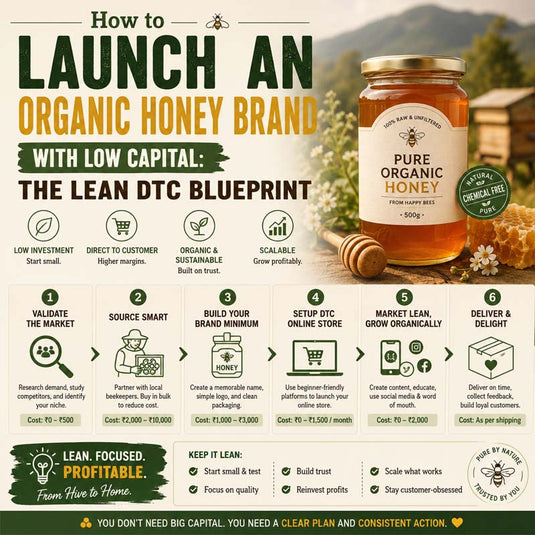
How to Launch an Organic Honey Brand with Low Capital: The Lean DTC Blueprint
The global demand for clean-label, certified organic honey is surging, creating a massive opportunity for direct-to-consumer (DTC) brands. However, many early-stage entrepreneurs mistake the premium positioning of organic honey for an ultra-high cost of entry. They assume that launching a brand requires investing heavily in commercial filtration setups, automated bottling lines, and massive storage warehouses.
The reality of modern supply chains is completely different. By embracing an asset-light, lean operational model, you can launch a premium, compliant, and highly scalable organic honey brand with minimal upfront capital. This guide maps out the exact blueprint to take your brand from a concept to a consumer-ready retail product without draining your savings.
1. The Strategy: Asset-Light Sourcing
The secret to launching with low capital is avoiding capital expenditure (CapEx). Instead of buying machinery or managing agricultural land, your goal is to find an integrated partner who has already built the infrastructure.
By leveraging an established honey contract manufacturing partner, you instantly gain access to high-tier operational advantages without the associated costs. Look for an institutional supplier backed by a direct, ethical network of certified apiarists and indigenous harvesting communities. This allows you to secure highly premium, raw, and traceably harvested certified organic honey while keeping your overhead non-existent.
2. Overcoming the MOQ Hurdle on a Budget
The biggest roadblock for bootstrapping DTC brands is the Minimum Order Quantity (MOQ). Most tier-1 contract manufacturers require a full container load (FCL)—upwards of 20 metric tons—to run their automated production lines.
To launch with low capital, you must deploy a phased production strategy:
- Phase 1: Small-Batch Market Validation: Negotiate specialized pilot-plant runs or small-batch production windows. Many manufacturers offer low-investment B2B service structures—sometimes starting around a 10,000 Rs initial threshold—specifically designed to nurture emerging brands.
- Phase 2: Use Standardized Retail Components: Avoid custom-molded glass or proprietary plastic shapes during your first production run. Choose the manufacturer's in-stock, standard retail containers (like classic hex glass jars or ergonomic wide-mouth PET containers). This removes custom tooling fees entirely.
- Phase 3: Scale Volumetrically: Once your brand achieves clear market traction and steady sales loops on platforms like Shopify or Amazon, you can seamlessly scale your inventory up to a full container setup without disrupting your product continuity.
3. High-Margin Product Architecture
When capital is tight, you cannot afford to compete on price in the mass-market commercial honey space. Instead, you must maximize your gross margins by positioning your brand at an ultra-premium, specialized tier.
Target High-Intent, Premium Niches
| Honey Variety | Visual & Sourcing Profile | Consumer Position | Market Margin Strategy |
|---|---|---|---|
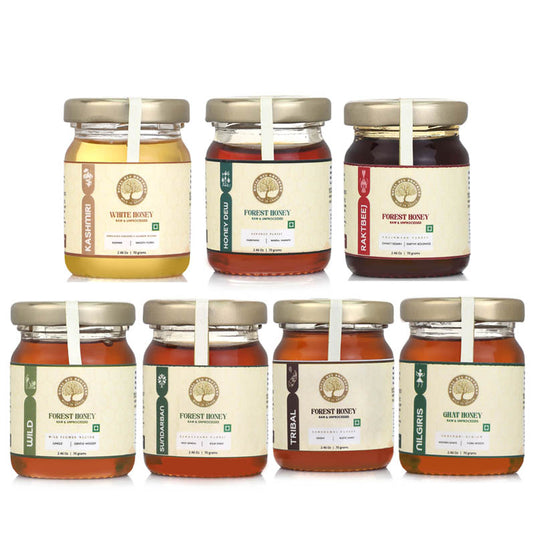
| Certified Organic Wild Honey | Sourced deep from protected forest belts completely free from chemical or agricultural spray zones. | Purest Tier Apiculture | Commands an exceptional price premium from health-conscious, clean-label purists. |
| Monofloral Masterpieces | Rare, seasonal single-source honeys such as Eucalyptus, Lychee, or creamy Mustard honey. | Gourmet/Artisanal Culinary | Targets the high-end gifting, boutique grocery, and direct-to-consumer foodie demographics. |
| Gourmet Polyfloral Blends | Deep, mineral-rich wild forest polyfloral profiles that naturally resist rapid crystallization. | Clean-Label Daily Wellness | Serves as a high-volume, reliable lifestyle baseline for health supplement lines. |
4. Where to Invest vs. Where to Bootstrap
When launching with low capital, ruthlessly prioritize where every single dollar or rupee goes. Misallocating capital early on is the number one reason emerging DTC brands fail.
Where to Invest (Non-Negotiable)
- Rigorous Laboratory Verification: Never compromise on product safety. Your manufacturing partner must back every batch with an audit-ready Certificate of Analysis (COA). To protect your brand from quality disputes, ensure your batches pass advanced Nuclear Magnetic Resonance (NMR) Spectroscopy and Stable Isotope Ratio Analysis (SIRA) testing to prove absolute freedom from adulterated C3/C4 sugar syrups.
- Regulatory & Food Safety Compliance: Ensure your production is carried out in an asset that ticks every global food safety governance box: FSSAI, US FDA registration, and ISO 22000 / BRCGS compliance.
- Tactile Brand Identity: Spend your capital on elite graphic design for your labels and digital storefront. A premium brand lives or dies by its visual identity.
Where to Bootstrap (Save Your Capital)
- Inventory Hoarding: Do not tie up cash in massive product stock. Keep your inventory lean and fast-moving.
- Physical Infrastructure: Rent nothing. No offices, no blending spaces, and no fulfillment warehouses. Utilize your contract manufacturer's turn-key services—from precision automated filling and batch-serialized labeling to final protective master-pack boxing.
- Logistics Handling: Let your partner handle shipping preparation. Your product should arrive at your third-party fulfillment center (3PL) completely ready for direct customer dispatch.
5. Launch Protocol for Lean DTC Brands
To successfully execute this lean launch strategy, follow this structured onboarding timeline:
- Secure Functional Evaluation Samples: Before committing capital, request a physical sampling kit containing your chosen certified organic or monofloral honey variety housed in standard retail glass or squeeze containers.
- Verify Traceability Documentation: Review the independent lab reports to ensure complete chemical purity and geographic authenticity.
- Finalize Digital Assets: While your contract partner runs production, filling, and master box assembly, build your digital store and pre-launch marketing assets.
- Direct-to-Consumer Dispatch: Have your completed retail units shipped directly from the production facility to a domestic or international fulfillment center, leaving you completely free to focus on brand growth and customer acquisition.
Why Partner with Royal Bee Brothers?
At Royal Bee Brothers, we are deeply committed to nurturing the next generation of premium wellness and agriculture brands. Our dedicated OEM, Private Label, and Contract Manufacturing Division offers low-investment entry options tailored specifically for emerging DTC enterprises.
By bridging the gap between an elite network of over 15,000 certified apiarists and state-of-the-art, NMR-tested automated processing lines, we handle the entire heavy lifting—formulation, filtration, filling, branding, and export logistics—allowing you to launch a world-class, market-ready organic honey brand with minimal capital overhead.
Official Corporate Email: info@royalbeebrothers.com
Corporate Sourcing Desk: Royal Bee Brothers Brand Incubator Division