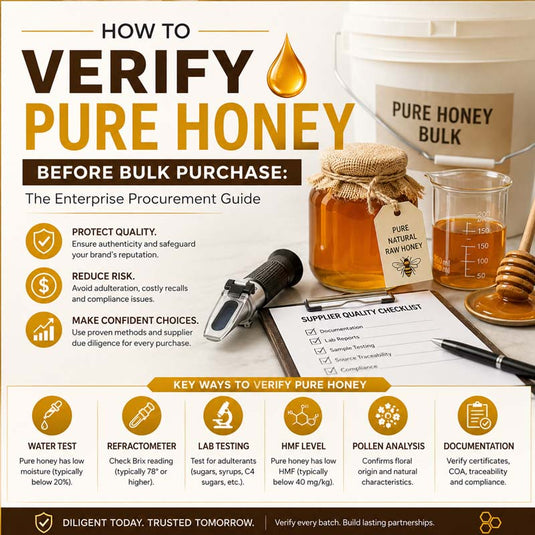
How to Verify Pure Honey Before Bulk Purchase: The Enterprise Procurement Guide
For corporate procurement officers, food product developers, and premium wellness brand owners, bulk honey sourcing carries a high degree of supply chain risk. Honey is one of the most economically adulterated food commodities globally. Industrial-scale adulteration has progressed far beyond simple sugar-water dilution; modern adulterated honey frequently utilizes bio-engineered, high-fructose C3 and C4 plant syrups (derived from cane, corn, rice, and sugar beets) that easily bypass legacy laboratory analysis.
When purchasing honey in multi-ton volumes, a single bad batch can lead to catastrophic retail recalls, regulatory fines, the loss of import/export licenses, and irreversible damage to your brand equity. Relying on superficial sensory checks like taste, color, or archaic home tests (such as the water drop or matchstick test) is entirely insufficient for industrial validation.
Protecting your procurement pipeline requires an institutional framework built around advanced laboratory analytics, traceably documented chemical profiles, and international safety certifications. This comprehensive guide details the exact analytical protocols, documentation frameworks, and testing standards required to verify honey purity before finalizing a bulk purchase agreement.
1. Demystifying the Honey COA (Certificate of Analysis)
A Certificate of Analysis (COA) is the primary legal and chemical baseline required for any wholesale food transaction. A bulk honey vendor must supply a batch-specific COA before any raw material transfers or payments are issued. However, simply receiving a document marked "passed" is not enough; procurement teams must know how to audit the specific chemical markers within the report.
A gold-standard honey COA evaluates several core parameters that dictate both the regulatory legality and the structural stability of the product:
Moisture Content
- Standard Threshold: Maximum 18% to 20% (depending on regional regulatory frameworks).
- Procurement Impact: High moisture content (above 20%) creates a severe operational risk for bulk storage. Excess water allows wild yeasts naturally present in honey to trigger fermentation, turning an expensive bulk shipment into industrial vinegar. Low moisture signifies stable, shelf-ready raw material.
Hydroxymethylfurfural (HMF) Levels
- Standard Threshold: Maximum 40 mg/kg (up to 80 mg/kg allowed for honeys sourced from tropical climates).
- Procurement Impact: HMF is an organic compound created by the thermal decomposition of sugars. It serves as a direct indicator of honey age and heat exposure. A high HMF reading proves that the honey has either been subjected to excessive pasteurization temperatures (which destroys beneficial enzymes and alters flavor profiles) or has degraded due to improper, long-term warehouse storage.
Diastase Activity
- Standard Threshold: Minimum 8 Schade units.
- Procurement Impact: Diastase is a natural enzyme introduced into honey by honeybees. Because enzymes break down rapidly under heat, low diastase activity paired with high HMF levels confirms that the honey has been overheated or artificially altered, invalidating "raw" or "unprocessed" product claims.
Fructose-to-Glucose (F/G) Ratio
- Standard Threshold: Varies by floral variety (typically 1.1 to 1.4 for fluid honeys).
- Procurement Impact: The balance between fructose and glucose dictates how quickly a specific batch will crystallize. For instance, high-glucose varieties like Mustard honey naturally crystallize into a thick, creamy paste very quickly, whereas high-fructose varieties remain fluid for extended periods. Understanding this ratio allows brand managers to match raw inventory to their specific packaging equipment (e.g., glass jars vs. anti-drip squeeze bottles).
2. Advanced Laboratory Testing: The Technical Standard
Legacy laboratory methods like the Stable Isotope Ratio Analysis (SIRA) remain highly effective at detecting C4 plant sugars (derived from corn and sugar cane). However, modern, sophisticated adulteration methods increasingly utilize highly refined C3 plant syrups derived from rice, wheat, and sugar beets. These syrups match the carbon-isotope footprint of natural honey perfectly, rendering traditional SIRA testing blind.
To absolute-proof a bulk procurement pipeline against economic fraud, enterprise buyers must demand advanced, multi-dimensional laboratory analysis from independent, globally accredited testing networks (such as Eurofins or Intertek).
What Advanced Testing Can Evaluate:
Modern multi-tiered analytics go deep into the molecular matrix of the shipment. Advanced testing protocols can systematically evaluate:
- Sugar profile: Mapping the exact distribution of naturally occurring fructose, glucose, sucrose, and maltose.
- Moisture: Ensuring precise water-to-sugar balance to guarantee shelf stability.
- Acidity: Measuring pH and free acidity to detect early signs of fermentation or chemical shifts.
- Enzyme activity: Verifying active diastase and invertase to confirm raw, unprocessed status.
- Hydroxymethylfurfural (HMF): Quantifying thermal degradation or age-related breakdown.
- Pollen and source indicators: Isolating microflora particles to confirm biological origin.
- Syrup adulteration markers: Tracking exogenous industrial corn, cane, or foreign starch inputs.
- Invert sugar signals: Revealing chemically split sucrose additions meant to mimic natural profiles.
- Microbial load: Screening for yeasts, molds, and bacterial spores to fulfill absolute safety protocols.
- Mineral content: Determining natural trace element signatures inherent to the soil and flora.
- Contamination risk: Detecting trace veterinary antibiotics, heavy metals, or pesticide residues down to parts-per-billion limits.
Advanced Methods May Include:
To accurately assess these complex parameters, modern high-throughput laboratories deploy an advanced suite of methodologies:
- NMR-based screening: Capturing a comprehensive, non-destructive metabolic "fingerprint" of the sample's molecular structure to detect hidden sugars and verify geographical origin with absolute certainty.
- Sugar profile analysis: Utilizing Liquid Chromatography-Isotope Ratio Mass Spectrometry (LC-IRMS) to measure independent carbon isotope ratios of individual sugar fractions.
- Microscopy / pollen-related evaluation: Executing melissopalynological audits to identify and count pollen grains, verifying floral authenticity (e.g., monofloral claims).
- Physicochemical profiling: Running automated testing arrays for electrical conductivity, refractive index, and specific gravity.
- Targeted adulteration detection: Deploying specific high-performance liquid chromatography (HPLC) methods to catch specific cheap industrial syrup additions.
- Advanced pattern recognition / machine-learning assisted analysis: Running the collected spectrum data against massive global databases via machine-learning algorithms to detect anomalies, trace botanical sources, and expose complex, multi-tiered fraud patterns.
3. Pure Honey Certification & Regulatory Compliance
A robust quality assurance program requires aligning your supply chain with top-tier third-party certifications and regulatory bodies. Validated certifications guarantee that the manufacturing asset operates under strict sanitary, ethical, and organic control protocols.
When auditing a potential supplier's institutional credentials, verify the following foundational certifications:
Organic Traceability Certifications
For brands specializing in premium health products, verifying third-party organic credentials is standard practice. Ensure your supplier holds valid, cross-border certifications such as NOP (USDA Organic), EU Organic, or equivalent regional organic standards. These frameworks require complete, unannounced audits of the apiary locations, verifying that the hives are situated in pristine wilderness areas entirely free from synthetic agricultural chemicals, pesticides, or industrial runoff.
Global Food Safety Initiative (GFSI) Frameworks
The processing facility must be accredited under universally recognized food safety management structures, such as:
- BRCGS (Brand Reputation through Compliance Global Standard)
- ISO 22000 / FSSC 22000 (Food Safety System Certification)
- HACCP (Hazard Analysis Critical Control Point)
International Custom Clearance Approvals
If your brand involves cross-border distribution across major global markets like the United States, Europe, or the Middle East, ensure the factory maintains active regulatory clearances, including an active US FDA Registration and localized food authority clearances (such as FSSAI in India or APEDA RMP approval) to streamline maritime customs processing and eliminate costly port delays.
4. Bulk Honey Verification Protocol
To implement an institutional procurement system that removes human error and protects your capital, execute this structured four-step bulk verification framework before approving a wire transfer:
Step 1: Pre-Purchase Document Review
Request a complete pre-purchase data package for the specific batch under review. This package must include a recent, batch-serialized COA alongside an independent NMR analysis sheet. Verify that the batch number stamped on the laboratory documentation directly corresponds to the inventory identifiers allocated to your order.
Step 2: Independent Sample Retention (The Live Draw)
Never base a multi-ton financial commitment solely on a pre-packaged sample vial sent directly by a sales team. Request a random, live sample draw from the actual bulk containers (HDPE pails, epoxy-lined steel drums, or industrial totes) holding your inventory. Split this sample into two parts: send one part to an independent, certified laboratory for isolated purity verification, and retain the second part in an airtight archive container to serve as your baseline control asset.
Step 3: Physical Inspection of Bulk Container Integrity
Prior to transit container loading, verify that all bulk storage assets are fitted with high-security, tamper-evident structural seals. Every individual drum or tote must be wrapped with a serialized locking mechanism. Recording these unique serial numbers on the bill of lading protects the shipment against mid-transit material substitution or unrecorded environment exposure.
Step 4: Final Arrival Verification & Matching
Upon arrival at your manufacturing facility or third-party logistics center (3PL), audit the container serial numbers against the shipping manifest. Conduct a final quick-check on moisture and batch coding before integrating the raw material into your packaging or bottling lines. This ensures complete supply chain transparency and product continuity from the hive to the retail shelf.
The Strategic Procurement Solution
Building a premium, globally compliant honey brand requires securing a manufacturing partner who treats chemical purity and supply chain transparency as foundational pillars rather than a checklist item.
At Royal Bee Brothers, our dedicated OEM, Private Label, and Contract Manufacturing Division provides large-scale enterprise buyers with an absolutely transparent supply chain infrastructure. Operating a state-of-the-art facility capable of delivering up to 60 Metric Tons per day, we partner with a direct, ethical fair-trade network of over 15,000 certified apiarists across India's most pristine ecological zones.
Every single drop of conventional, monofloral, and certified organic forest honey we process undergoes rigorous independent quality defense, including advanced NMR spectroscopy, SIRA testing, and extensive chemical residue profiling through globally accredited testing systems. Whether you are launching a specialized retail line or scaling an enterprise consumer portfolio, we provide full, traceably documented verification parameters that safeguard your brand equity and delight your target audience.
For comprehensive technical specifications, institutional pricing models, or to request an audit-ready, customized honey evaluation sampling kit, contact our international sourcing team today.
- Official Corporate Email: info@royalbeebrothers.com
- Corporate Sourcing Desk: Royal Bee Brothers Industrial Procurement & Compliance Division
Technical Appendix: Related Sourcing Resources
To learn more about setting up an efficient, low-overhead direct-to-consumer infrastructure, managing minimum order thresholds, and selecting optimized container styles for specialized retail deployment, read our foundational industry guide to private label honey manufacturing.