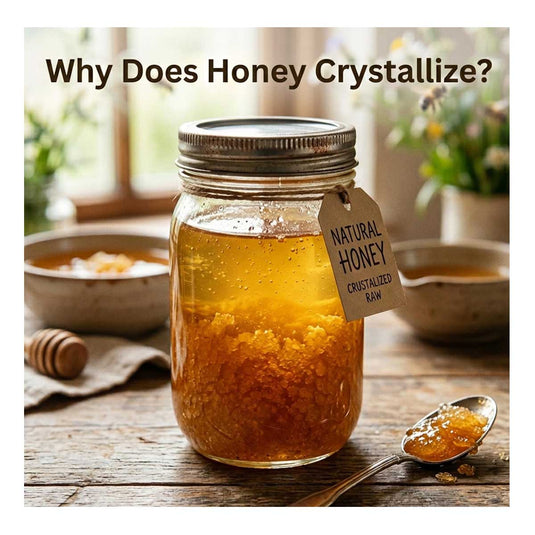
Why Honey Crystallizes: Science, Myths and Complete Guide
If you have ever opened a jar of honey and found it thick, grainy, creamy, or partially solidified, you may have wondered:
- Has my honey gone bad?
- Is this fake honey?
- Why did my honey crystallize?
The short answer is simple:
Crystallization is one of the most natural and scientifically expected behaviors of real honey.
In fact, for many raw and minimally processed honeys, crystallization is often a positive sign — not a defect.
At Royal Bee Brothers, we believe consumers deserve clarity, not confusion. So here we’ll explain what honey crystallization really is, why it happens, which honeys crystallize faster, whether crystallized honey is still safe, and how to gently return it to liquid form without damaging its natural character.
What Is Honey Crystallization?
Honey crystallization (also called granulation) is the natural process in which part of the honey’s sugar content — mainly glucose — separates from the liquid phase and forms tiny crystals.
Honey is not a simple syrup. It is a supersaturated sugar solution made primarily of:
- Fructose
- Glucose
- Water
- Small amounts of enzymes, acids, minerals, amino acids, pollen traces, and plant-derived compounds
Crystallization is not spoilage. It is a physical phase change in a natural sugar solution.
Why Does Honey Crystallize?
The main reason is glucose solubility.
- Fructose is highly soluble in water
- Glucose is less soluble in water
When honey contains more dissolved glucose than water can hold, the excess glucose forms crystals.
Over time, honey may become:
- Fine and creamy
- Grainy
- Semi-solid
- Fully solid
Key Factors That Control Crystallization
1) Glucose-to-Fructose Ratio
Higher glucose honey crystallizes faster, while higher fructose honey stays liquid longer.
2) Moisture Content
Lower moisture increases crystallization, while higher moisture delays it.
3) Storage Temperature
Cool temperatures speed up crystallization, while warmth slows it down.
4) Natural Particles
Pollen, wax, and air bubbles act as seed points for crystals.
5) Processing
Heating and filtering delay crystallization but do not stop it permanently.
Does Crystallized Honey Mean It Is Pure?
Not always, but often it is a positive sign.
Many pure honeys crystallize, but some remain liquid depending on composition and storage.
Is Crystallized Honey Safe?
Yes, crystallized honey is safe and edible if it has not fermented.
It remains nutritious and can be used in:
- Tea
- Toast
- Baking
- Spreads
Crystallization vs Fermentation
Crystallization
- Thick or grainy texture
- No sour smell
Fermentation
- Sour or alcoholic smell
- Bubbles or foam
- Gas formation
Why Raw Honey Crystallizes Faster
Raw honey contains pollen, wax, and natural particles that promote crystallization.
Why Some Honey Stays Liquid Longer
Commercial honey may be heated and filtered, delaying crystallization.
How to Decrystallize Honey Safely
- Keep the jar closed
- Place it in warm water
- Maintain temperature around 35–40°C
- Wait and stir gently if needed
Avoid overheating, boiling, or microwaving.
Buy Pure Comb Honey Online
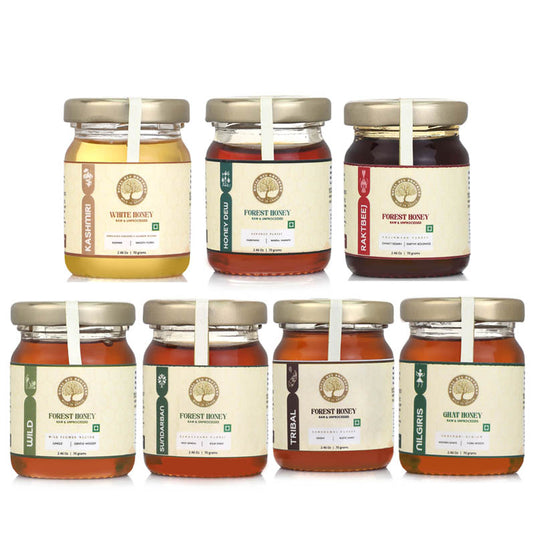
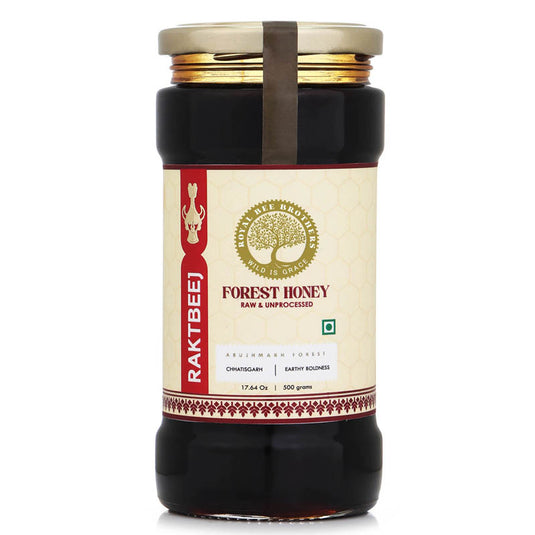
🌿 Experience Real Forest Honey
Looking for authentic Raw honey? Discover premium quality honey sourced naturally and ethically.
✔ 100% Raw & Unprocessed
✔ Forest-Sourced
✔ Rich in Nutrients
✔ Premium Quality
What Is Creamed Honey?
Creamed honey is controlled crystallized honey with a smooth texture.
Common Myths
- Pure honey never crystallizes – False
- Crystallized honey is fake – False
- Liquid honey is better – False
- Crystals mean expiry – False
Storage Tips
- Store at room temperature
- Avoid refrigeration
- Keep jar sealed
- Use dry spoon
Crystallization is natural, scientific, and expected. It is not a flaw but a normal behavior of real honey.
Not all crystallized honey is pure, but pure honey often crystallizes.
You can also explore our related articles on honey to learn more.
Scientific References on Honey Crystallization
1. Honey Crystallization: Mechanism, Evaluation and Application
Crystallization of honey is a natural phenomenon and does not indicate spoilage or adulteration.
2. Why Does Honey Crystallize? (Agriculture Institute)
https://agriculture.institute/hive-products-beekeeping-economics/why-does-honey-crystallize/
Honey crystallization is completely natural and spontaneous. It is not caused by adulteration, and pure honey often crystallizes.
3. FSSAI Clarification on Crystallized Honey
Crystallization of honey is a natural phenomenon and does not necessarily mean the honey is adulterated or spoiled.