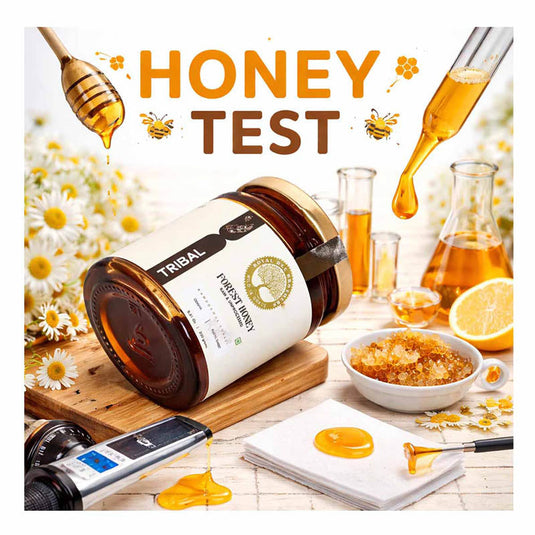
How to Test Honey at Home: 10 Popular Tests Explained by Science
If you are wondering how to test honey at home, you've probably heard about the water test, thumb test, flame test, paper test, and crystallization test. This guide explains which honey purity tests work, which are myths, and what science says about identifying real honey.
People want raw honey, pure honey, unprocessed honey, and real forest honey — but what they often get is something very different. For evaluating real vs fake honey India, many consumers rely heavily on viral “home tests” to check honey purity. You’ve probably seen them too:
- The water test
- The thumb test
- The flame test
- The paper test
- The crystallization test
These methods are everywhere across digital spaces.
But here is the uncomfortable truth: A sample of honey can pass multiple home tests seamlessly and still be highly adulterated. Conversely, a genuine, completely raw wild forest honey can fail a basic home experiment and still be completely authentic.
This is a deep, science-backed, easy-to-understand guide that explains:
- What pure honey actually means according to physical chemistry
- Which home honey tests provide interesting observations (and which are total myths)
- Why pure honey behaves uniquely based on its floral source, moisture, harvest season, and storage
- Why sophisticated fake honey can mimic “real” honey structures surprisingly well
- Why laboratory validation remains the only reliable proof of absolute authenticity
Real vs Fake Honey in India: How to Identify Pure Honey
In India, distinguishing real vs fake honey is exceptionally challenging due to widespread, industrial-scale adulteration and misleading package labeling. To navigate this landscape safely, modern consumers must understand how to check pure honey using facts rather than viral myths. Relying on baseline scientific profiles and strict FSSAI honey purity standards will safeguard your health far better than relying on home kitchen folklore.
Why Testing Honey Matters More Than Ever
Honey is globally recognized as one of the most frequently targeted foods for commercial adulteration. Across many independent investigations and academic food safety evaluations, commercial retail honeys have been exposed as:
- Diluted heavily with specialized high-fructose corn syrup, cane sugar syrup, or hidden rice syrup.
- Altered with designer invert sugar solutions constructed specifically to bypass old testing standards.
- Aggressively flash-heated to unnaturally halt crystallization and create an artificially permanent fluid presentation.
- Ultra-filtered under extreme pressure to intentionally strip out native pollen grains, masking the honey's geographic origin.
- Chemically standardized to ensure a perfectly uniform, golden color and uniform fluid thickness.
This means that even if a retail bottle looks perfect, smells pleasant, or passes a common kitchen experiment, it may still be profoundly altered. Modern consumers require validation backed by physical chemistry.
What Does “Pure Honey” Actually Mean?
The descriptor "pure" is stamped across nearly every single jar in the global honey aisle—but it is rarely applied with true integrity. A commercial label might say “pure honey,” yet the product inside could be pasteurized, blended, micro-filtered, and stripped of its primary health advantages.
True pure honey must satisfy these explicit criteria:
- Raw: Settled gently and never processed at temperatures exceeding natural bee hive thresholds (approx. 35°C).
- Unprocessed: Free from heavy industrial refining, vacuum filtering, or artificial chemical stabilization.
- Clean Matrix: Completely void of added external corn syrups, inverted sugar profiles, or hidden sweeteners.
- Nutritionally Intact: Rich in native structural micro-elements, wild pollens, and live organic enzymes.
The Natural Composition of Real Honey
One primary reason honey is incredibly difficult to judge without professional equipment is its inherent natural complexity. Honey gathered by honeybees is not a single uniform formula. Unmanipulated raw batches display entirely unique baseline traits based on their environment:
- Wild Forest Flora: Yields deep, highly complex multi-floral profiles packed with diverse tree minerals and robust earthy tones.
- Monofloral Blossoms: Dictates specific, distinct texturing, colors, and crystallization speeds determined by a single target plant type.
- Humid Ecosystems & Mountain Terrains: Naturally alters the baseline moisture percentages of the harvest, directly impacting physical viscosity.
Because of these ecological variations, true unmanipulated honey defies rigid industrial consistency, varying naturally from season to season.
10 Popular Home Tests for Honey Evaluated
Step-by-Step Instructions:
- Fill a clean, clear glass with roughly three-quarters of room-temperature or ambient water.
- Take a clean teaspoon and scoop up a generous, solid portion of the honey sample.
- Hold the spoon directly over the glass and allow a steady stream of honey to drop gently into the water.
- Observe the honey's physical path down through the liquid column and see if it aggregates at the bottom or dissolves instantly.
Step-by-Step Instructions:
- Place a single, clean sheet of standard white printing paper or high-absorption blotting paper flat on a dry table.
- Using a clean dropper or a spoon, deposit a single, controlled drop of your honey directly onto the center of the paper.
- Leave the sample undisturbed for approximately 5 to 10 minutes.
- Flip the sheet of paper over to examine the reverse side for wetness, ring expansion, or structural absorption.
Step-by-Step Instructions:
- Procure a standard dry wooden matchstick from a fresh matchbox.
- Dip the active chemical tip of the matchstick directly into your honey sample, coating it completely in a thin layer.
- Remove the matchstick and gently wipe away any excessive dripping from the sides.
- Strike the coated match tip firmly against the matchbox striking pad to see if it ignites or fails.
Step-by-Step Instructions:
- Thoroughly wash and completely dry your hands, focusing on your thumb.
- Place a single drop of the honey sample directly onto the clean surface of your thumbnail.
- Hold your thumb completely still and watch the honey drop closely for 2 to 3 minutes.
- Observe whether the fluid retains its rounded, bead-like structural integrity or immediately flattens and spills down your finger.
Step-by-Step Instructions:
- Take a clean, small ceramic bowl or a small glass cup.
- Add one tablespoon of your honey sample and combine it with 2 to 3 tablespoons of pure water.
- Stir the mixture gently until the honey is completely dissolved into the water.
- Add 3 to 4 drops of standard commercial white vinegar into the solution and observe the surface for foaming or bubbling.
Step-by-Step Instructions:
- Pour a sample of your honey into a clear glass jar and seal the lid tightly.
- Place the jar inside your kitchen refrigerator or keep it in a cool space (around 10-14°C).
- Leave the jar completely undisturbed for several weeks.
- Check the sample periodically to see if it develops fine white grains, a cloudy look, or solidifies into a thick paste.
Step-by-Step Instructions:
- Take a clean, small metal cooking spoon and add half a teaspoon of your honey.
- Hold the spoon carefully over an open flame, such as a gas burner or a candle.
- Watch the honey closely as it heats up and begins to simmer.
- Observe whether the fluid bubbles smoothly and darkens gradually, or if it produces loud popping noises and smokes heavily.
Step-by-Step Instructions:
- Open your jar of honey and take a deep, slow breath to evaluate its initial aroma.
- Take a small amount of honey on a spoon and place it directly onto your tongue.
- Allow the honey to melt slowly in your mouth, noting its flavor shifts and how it feels on your palate.
- Pay attention to the finish: check if you notice any subtle botanical notes or if it leaves a simple, lingering blast of flat sweetness.
Step-by-Step Instructions:
- Obtain a fresh, soft slice of standard sandwich bread.
- Spread a generous, even layer of your honey sample across the top of the bread slice.
- Set the bread aside on a plate and leave it undisturbed for roughly 5 to 10 minutes.
- Examine the bread's texture: check if the surface has become firm and crisp or if it has turned soggy and soft.
Step-by-Step Instructions:
- Locate a batch-certified honey brand or collect a clean sample of your honey in a sterile container.
- Submit the sample to an accredited national laboratory (such as an NABL-certified facility in India).
- Request a comprehensive quality analysis package, focusing on sugar profiles and purity markers.
- Review the certified data report once completed, paying close attention to key markers like Fiehe’s test, HMF values, and diastase enzyme activity.
At-a-Glance: Purity Testing Effectiveness Comparison
To summarize how standard observational diagnostic checks compare to clinical evaluations, review the analysis matrix below:
| Home Test Type | Useful as a Clue? | Scientifically Reliable? |
|---|---|---|
| Water Test | Yes (Roughly) | No |
| Thumb Test | Yes (Viscosity) | No |
| Flame Test | Highly Limited | No |
| Crystallization | Useful Indicator | No |
| Lab Testing (NMR/Fiehe's) | Yes | Yes (Definitive) |
The Big Truth Most Honey Blogs Don’t Tell You
Truth #1: Fake Honey Can Easily Pass Home Tests
Sophisticated adulterated syrups are engineered to perfectly imitate the density, color, viscosity, surface texture, and sweetness profile of genuine honey. A fake honey can sink in water, feel thick on your thumb, and look golden—which is why viral shortcuts can be misleading.
Truth #2: Pure Honey Can Fail Home Tests
Genuine raw honey can vary across batches due to natural moisture differences, seasonal changes, wild floral diversity, and storage temperatures. This is especially true for wild-harvested forest honey, which doesn't follow a rigid industrial formula.
Truth #3: Honey Is One of the Most Faked Foods in the World
Globally, honey is highly vulnerable to adulteration due to its market value, how easily it can be diluted, and how difficult it is for consumers to verify without lab equipment.
Truth #4: Even Taste Alone Is Not Enough
Modern adulterated honey blends can closely mimic the sweetness, thickness, and mouthfeel of real honey, meaning even experienced consumers can be misled by taste alone.
What Beekeepers & Experienced Buyers Say
Relying on home tests alone is not enough to guarantee true authenticity. Experienced buyers follow a clear rule of thumb: use home tests as minor indicators, use common sense as protection, and use independent laboratory validation reports to guide your purchasing decisions.
The Royal Bee Brothers Promise
What We Stand For
- 100% Raw Honey: Kept exactly as the hive intended without high-heat processing.
- No Overheating: Handled carefully to preserve biological activity.
- No Artificial Standardization: Every single harvest reflects its natural season.
- Unfiltered & Rich: Retains its native pollen structure and raw characteristics.
Zero Adulteration Commitment
- No added sugar syrup, rice syrup, or corn syrup
- No hidden invert syrup blending or artificial sweeteners
Forest-Sourced Authenticity
Our honey is harvested directly from wild ecosystems, ensuring a raw profile that reflects genuine seasonal and regional variation.
Transparency Over Hype
We do not ask customers to blindly believe structural claims. We provide clear, verifiable validation proof for every bottle.
Lab Testing in NABL Certified Labs
Testing ensures quality through validated systems and laboratory standards.
Parameters Tested
- Fiehe’s Test & Invert Sugar Test
- Added Sugar Check (Sucrose, Rice, Corn Syrups)
- Ash Content, Acidity, and pH Value
- Diastase Activity & HMF Levels
- Bacterial Count & Microbial Contamination Safeties
- Tested extensively in fully standardized laboratory environments.
Why These Tests Matter
They clearly identify adulteration, verify enzyme health, ensure food safety, and validate absolute origin authenticity. To ensure total transparency, our latest lab reports are always available on our website and included with every single bottle.
Why Our Honey Tastes Different
It reflects real forests, real flowers, and real ecosystems. It carries complex notes of wild blossoms and landscapes that still remember how to be wild.
How to Choose Better Honey (Expert Buying Advice)
Instead of relying only on viral tests, use a smarter evaluation checklist.
1) Read the Label Carefully
Verify that the ingredients list shows zero added sugars, glucose syrups, corn syrups, rice syrups, or artificial flavorings.
2) Choose Brands That Show Evidence
A trustworthy honey brand should be completely transparent about its batch records, harvest origins, and independent lab testing details.
3) Understand Crystallization Properly
Crystallization is a natural characteristic of raw honey. Liquid honey isn't automatically fake, and crystallized honey isn't automatically pure—context and floral source matter.
4) Pay Attention to Aroma and Taste
Real honey has a distinct character—ranging from floral and herbal to woody and earthy. If a product offers nothing but plain sweetness, it's worth asking questions.
5) Be Cautious of Ultra-Cheap Honey
Authentic honey involves careful foraging, seasonal variability, and quality testing. If the price feels too good to be true, it likely is.
Can You Test Honey at Home?
Yes — but only to a point. Home tests can help you observe basic thickness and aroma, but they cannot reliably identify advanced syrup adulteration or enzyme degradation. The final answer is simple: Home tests are helpful indicators, but lab testing is the only reliable proof.
Royal Bee Brothers Promise of Purity
Raw. Unfiltered. Tested. Transparent.
- 100% raw honey with zero added sugars or processing syrups.
- NABL certified lab tested for Fiehe’s, HMF, and Diastase values.
- Full transparency reports are available online and included with every purchase.
Scientific Reference Links
- Honey Adulteration Review: Read scientific review on sugar syrup detection methods
- Honey Composition & Authenticity: Read composition & NMR authenticity research paper
- Advanced Honey Authentication Methods: Read advanced honey authenticity screening systems
- HMF + Diastase Quality Study: Read thermal impact on HMF and diastase values
Explore Our Knowledge Base
Read our related educational guides to deepen your understanding of honey purity and natural wellness: