The Liquid Gold Standard: Raw Honey vs. Processed Honey
In an era dominated by hyper-processed industrial foods and deceptive grocery labels, the word "pure" has been thoroughly hollowed out. Walk down the aisle of any modern supermarket, and you will find rows of perfectly uniform, crystal-clear plastic squeeze bottles containing an amber liquid labeled as honey. It looks pristine, flows smoothly without hesitation, and never hardens. However, beneath this highly manicured surface lies a stark scientific truth: industrial commercialization has effectively stripped this ancient superfood of its soul.
For centuries, true honey was harvested directly from wild hives or traditional apiaries—untouched by high-heat machinery, unadulterated by corporate laboratory additives, and filled with active enzymes, defensive antioxidants, and native pollens. This is raw honey. Conversely, the vast majority of commercial honey sold globally is ultra-pasteurized, highly micro-filtered, and structurally altered. This is processed honey. To help conscious consumers make informed health choices, this guide explores the biological differences, production mechanics, and chemical realities of raw versus processed honey.
The Biological Definition of Raw Honey
To accurately evaluate the two types, we must establish a clear scientific baseline. True raw honey is defined as honey exactly as it exists within the honeycomb of the hive. It is a complex, living, unheated substance extracted solely through sedimentation, straining, or centrifugal force to separate substantial wax particles and bee debris from the liquid honey without applying intense thermal heat or high-pressure micro-filtration.
Because it undergoes zero industrial manipulation, raw honey remains packed with over 200 distinct bioactive compounds. It retains its natural, cloudy profile and carries unique microscopic traces of royal jelly, propolis, and live pollen grains. This chemical makeup directly accounts for the extensive, science-backed natural honey benefits celebrated by ancient medical systems and verified by modern clinical laboratories alike. Learn more about validating these indicators in our dedicated guide on How to Test Honey at Home.
Live Pollen Grains
Acts as a signature of botanical origin; supports seasonal allergy desensitization.
Propolis & Wax
Nature's defensive seal; rich in natural antimicrobial and antiviral traits.
Active Enzymes
Proteins like Diastase and Invertase that facilitate digestive vitality.
Pure Honey vs. Processed Honey: Defining True Purity
The distinction between pure honey and processed honey goes far beyond simple marketing terms; it is defined by structural integrity. Pure honey, taken directly from the hive, exists as a complex matrix of glucose, fructose, trace minerals, and living microorganisms. It is a living, whole product shaped entirely by the local ecosystem.
On the other end of the spectrum, processed honey is a highly engineered industrial commodity. To prevent natural crystallization and ensure a thin, uniform fluid that flows seamlessly through high-speed automated bottling machinery, factories break down the internal chemistry of the honey. While the product may have originated in a honeybee colony, the extensive manipulation transforms a medicinal, organic food into a clear, nutritionally depleted, simple syrup substitute. For a comprehensive look at how these differences affect overall health metrics, see our complete breakdown on Forest Honey vs Regular Honey.
Is Raw Honey Better Than Processed Honey? The Scientific Verdict
When assessing whether is raw honey better than processed honey, the biological evidence is overwhelming. Raw honey retains its natural chemical structure, preserving organic compounds, intact pollen matrices, and fragile digestive enzymes. This preservation directly shapes how the substance interacts with human metabolism.
Processed honey behaves in the body much like refined high-fructose corn syrup or white cane sugar. Because the enzymes that assist in sugar breakdown are non-existent, it enters the bloodstream rapidly, inducing sharp insulin spikes. Raw honey, however, naturally contains complex sugars alongside secondary plant metabolites and minerals. This balanced synergy allows the human body to process the natural sugars more gradually, reducing rapid glycemic load and offering metabolic stability that processed varieties cannot match.
Raw Honey vs. Processed Honey Benefits: A Functional Comparison
Evaluating raw honey vs processed honey benefits highlights why unrefined choices are superior for supporting daily wellness. When honey is left in its raw state, the active components work in harmony with your body's systems, providing protective properties that disappear completely once the honey undergoes industrial heating and micro-filtration. This functional variance is highly evident across unique regional harvests, such as our curated Essence of Seven Sisters line, which highlights the unmodified, native characteristics of distinct regional ecosystems across Northeast India.
The Anatomy of Processed Honey
Processed honey is engineered to fulfill corporate retail demands: it must not crystallize on shelves, it must look uniform across batches, and it must survive extreme global shipping environments. To achieve this commercial standard, industrial food brands depend heavily on two destructive production pillars: high-heat pasteurization and aggressive membrane filtration.
Does Heating Affect Honey Quality?
The answer is absolutely, and destructively. In corporate processing factories, raw honey is subjected to intense flash-pasteurization, typically involving heating the honey to temperatures between 65°C and 72°C followed by rapid cooling.
Industrial processors heat honey for two main operational reasons. First, heating melts microscopic sugar crystals, permanently preventing natural crystallization so the product remains liquid indefinitely on supermarket shelves. Second, it destroys wild yeasts to prevent fermentation during long ocean transits in hot container ships. However, this high heat fundamentally disrupts the honey's delicate chemical balance, denaturing fragile proteins and eliminating its health benefits.
Why Filtration Matters
Following high-temperature heating, commercial honey undergoes aggressive high-pressure micro-filtration. This process forces the liquefied honey through extremely fine membranes, often under 0.1 microns, to systematically remove all suspended particulates. While this removes visible wax particles, it also permanently strips out every trace of beneficial pollen grains.
Industrial brands prioritize removing pollen because it creates a perfectly transparent, clear liquid that consumers are conditioned to expect. However, this carries a hidden cost: without pollen, it is scientifically impossible to trace the geographic or botanical origin of the honey, leaving the supply chain vulnerable to adulteration with cheap, hidden corn syrups or synthetic sweeteners.
Does Heating Honey Destroy Nutrients? The Thermal Thresholds
To understand the biological decline of honey, we must analyze the thermal thresholds where specific health compounds degrade. So, does heating honey destroy nutrients? Yes, because specific live elements cannot survive exposure to high heat.
- 35°C (Natural Hive Baseline): The gold standard temperature maintained naturally inside a functional honeybee hive. At this level, all vitamins, volatile aromatics, and structural enzymes remain functional and biologically active.
- 40°C (Enzymatic Breakdown Point): Fragile proteins begin to experience structural damage. Invertase—the enzyme responsible for converting complex sucrose into simple, easily digestible sugars—denatures and loses its effectiveness.
- 55°C (Antimicrobial Degradation Point): Diastase and Glucose Oxidase are destroyed. This halts the chemical pathway through which honey naturally produces trace amounts of hydrogen peroxide, drastically lowering its tissue-healing and antibacterial properties.
- 65°C–72°C (Industrial Flash-Pasteurization Threshold): The extreme heating benchmark used in commercial bottling plants. At this stage, the living essence of the honey is entirely neutralized, converting it into an inactive, pasteurized sugar solution.
Unfiltered Honey vs. Filtered Honey: The Role of Microscopic Pollen
The operational divide between unfiltered honey vs filtered honey directly alters the physical and therapeutic value of the final product. Filtered honey is forced through synthetic industrial screens under heavy mechanical pressure. This process strains out the microscopic pollen grains, propolis particles, and trace honeybee proteins that naturally cloud raw honey.
Unfiltered honey bypasses this harsh step. It is simply poured through a basic, wide-gauge stainless steel gravity screen to catch stray pieces of beeswax or hive material while letting the microscopic elements pass through. Retaining these natural components keeps the honey's complex flavor intact and allows the natural pollens to support immune resilience against seasonal environmental irritants.
Raw Honey vs. Commercial Honey: A Structural Comparison
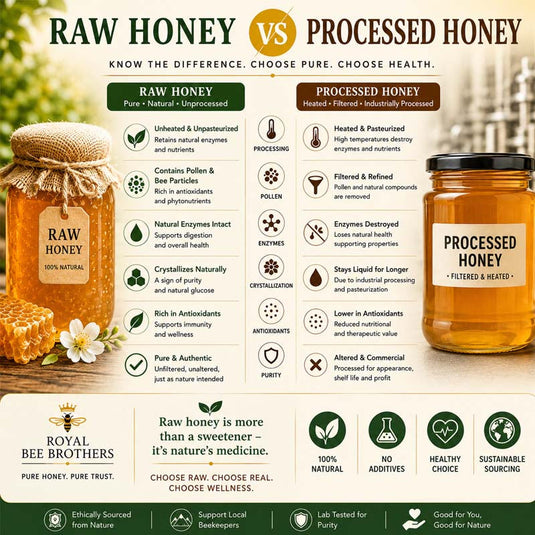
| Structural Feature | Raw & Unprocessed Honey | Processed Commercial Honey |
|---|---|---|
| Thermal Treatment | Never heated beyond normal hive temperatures (approx. 35°C). | Flash-pasteurized at high temperatures up to 72°C. |
| Pollen Content | 100% intact; preserves natural trace nutrients. | Systematically stripped out via high-pressure micro-filtration. |
| Enzymatic Value | Highly active; rich in Diastase, Invertase, and Glucose Oxidase. | Completely denatured and inactivated by thermal processing. |
| Crystallization | Natural and inevitable; forms solid, creamy structures over time. | Artificially suppressed; remains a clear liquid indefinitely. |
| Flavor & Aroma | Complex and diverse; reflects local wild forest blossoms. | Monotonous and overly sweet; loses delicate botanical notes. |
The Destructive Chemistry of Heat: The HMF Equation
When honey is heated or aged poorly, a critical chemical transformation occurs: its natural fructose sugars break down to form a compound called 5-Hydroxymethylfurfural (HMF). The accumulation of HMF serves as a primary scientific index used by international food safety bodies to identify heat damage and adulteration.
In completely fresh, raw honey, the concentration of HMF is nearly zero.
High HMF levels indicate that the honey's live properties have been compromised. International export laws strictly limit HMF levels to a maximum of 40 to 80 mg/kg, as elevated levels signal that the honey has been overprocessed into a basic, sweet syrup stripped of its active health properties.
Unprocessed Honey and the Power of Live Enzymes
The core health benefits of raw, unprocessed honey stem from its live enzymes. The most critical of these is Glucose Oxidase, an enzyme introduced by bees during honey production. When raw honey comes into contact with moisture, Glucose Oxidase naturally triggers a slow release of low-dose hydrogen peroxide, providing strong, natural antibacterial defense. This delicate enzyme is completely destroyed by commercial pasteurization, turning processed honey into a simple sweetener rather than a functional wellness food.
"When you heat honey to industrial levels to keep it perpetually clear, you trade its profound biological value for basic visual shelf appeal. Processed honey loses its medicinal qualities, transforming from an active superfood into an ordinary sugar substitute."
Raw Forest Honey Benefits: Deep-Forest Bio-Activity
Among the varieties of unheated honey, raw honey harvested directly from wild woodlands offers exceptional wellness properties. Understanding raw forest honey benefits reveals why it stands out from single-crop variants:
- Diverse Botanical Sourcing: Instead of relying on single agricultural crops treated with chemical pesticides, wild forest bees collect nectar from a vast array of deep-jungle medicinal plants, indigenous trees, and wild forest herbs.
- Elevated Mineral Concentrations: Laboratory mineral analyses indicate that uncultivated wild forest honey contains higher levels of essential minerals—including natural iron, magnesium, potassium, and zinc—than standard monoculture honey.
- Stronger Free-Radical Defense: The broad mix of forest flowers produces a deeper, darker honey rich in protective polyphenols and active flavonoids like pinocembrin, which help combat systemic oxidative stress.
The True Meaning of Natural Honey Benefits
Choosing authentic, raw honey connects you to a wide range of science-backed wellness benefits that commercial alternatives simply cannot replicate:
- Rich Antioxidant Network: Raw honey is packed with organic acids and powerful polyphenols, including flavonoids like pinocembrin, which help combat oxidative stress throughout the body.
- Natural Digestive Support: Thanks to its intact live enzymes, raw honey acts as a mild prebiotic, nourishing beneficial gut bacteria and supporting overall digestive health.
- Soothes Respiratory Discomfort: Clinical studies consistently demonstrate that raw honey effectively coats the throat and calms coughs, outperforming several common over-the-counter options for children over one year old.
- Immune Balance via Pollen: Consuming raw honey containing trace local pollens introduces micro-doses of natural flora, helping the body build resilience against seasonal environmental changes.
Discovering the Best Raw Honey in India
Finding the best raw honey in India means avoiding mass-produced commercial containers and seeking brands that practice traditional, non-destructive harvesting. Authentic raw honey relies entirely on pristine natural ecosystems and gentle handling that preserves the cold-extraction process.
The finest unpasteurized honey comes from India's dense forest reserves, mountain ranges, and rich tropical belts, where wild bees forage far from industrial pollution. These remote regions yield honey with distinct complex flavors, thick natural textures, and intact medicinal benefits that corporate processing methods strip away.
The Royal Bee Brothers Standard: Integrity and Heritage
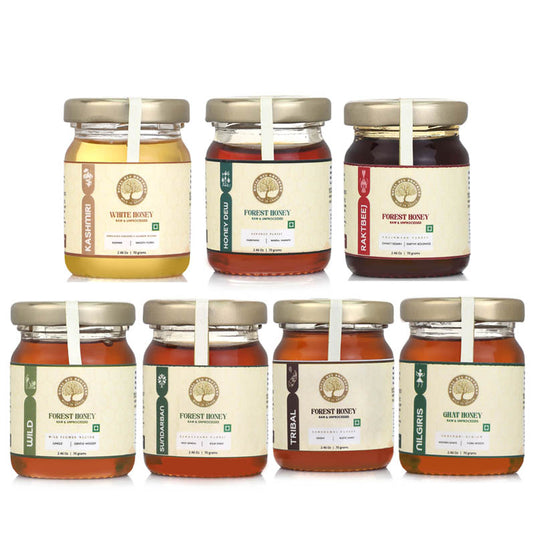
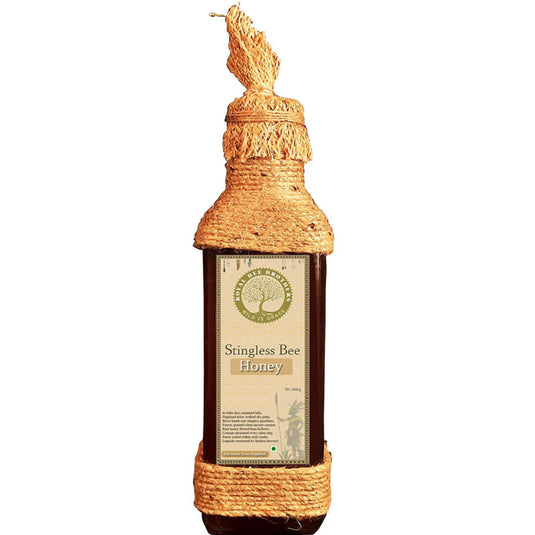
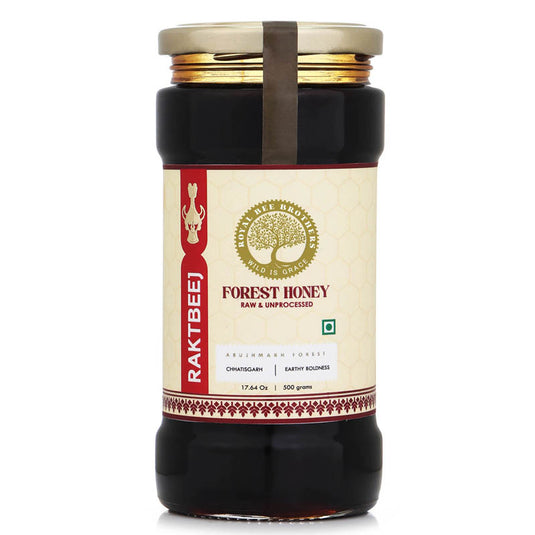
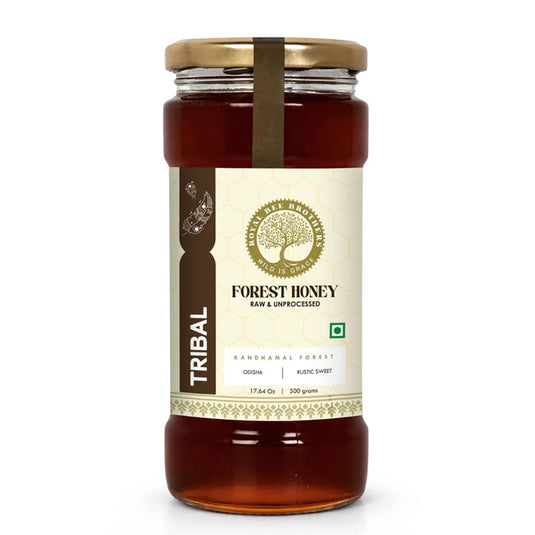
At Royal Bee Brothers, our commitment to natural honey goes far beyond standard market benchmarks. We build long-term, ethical partnerships with indigenous forest and tribal communities across India who have spent generations mastering the delicate, sustainable harvesting of wild forest honey. By supporting their traditional knowledge, we protect local forest ecosystems and secure a transparent supply chain built on ecological preservation.
Our processing model rejects the compromises of modern factories. Every drop of our honey is handled with absolute care—retaining its living enzymes, rich antioxidants, and authentic regional flavor profiles. This unyielding dedication to pure, chemical-free forest products is what sets our brand apart as the gold standard for pure, functional nutrition.
Frequently Asked Questions (FAQ)
True raw honey will not dissolve quickly or wash away easily in water. When a spoonful is dropped into a glass of ambient water, pure unprocessed honey settles as a distinct lump at the bottom of the glass, while adulterated or heavily processed honey begins to break apart and mix into the liquid immediately.
Crystallization is a natural and spontaneous chemical marker of completely unheated, authentic honey. The glucose molecules naturally separate from the water matrix and form stable crystal structures around native pollen grains. It does not mean the honey has spoiled; it proves its raw status.
While heating honey past hive temperatures does not create immediate dangerous toxins, it systematically alters its biological value. Heating denatures essential healing enzymes, destroys local pollen structures, and drastically increases HMF levels, lowering its quality from a functional superfood to a simple sweetener syrup.
Conclusion: Making an Authentic Choice
The difference between raw and processed honey goes far beyond appearance; it determines whether the product retains its functional health benefits or acts as a basic sugar syrup. While processed honey offers convenience and an everlasting liquid state, it sacrifices the enzymes, pollens, and organic compounds that make honey valuable in the first place.
At Royal Bee Brothers, we prioritize preserving this natural purity. Our wild forest honey is harvested sustainably alongside indigenous communities, gently strained to remove large wax fragments while keeping all beneficial pollens and live enzymes intact. By choosing raw, unfiltered honey, you support sustainable forest conservation and choose a living, whole food exactly as nature intended.