How Forest Honey Is Harvested: The Ancient Art of Collecting Nature’s Purest Honey
Table of Contents
Introduction
Forest honey is among the most extraordinary foods produced by nature. Unlike commercial honey collected from managed bee boxes, forest honey originates in untamed landscapes where wild bees build their nests high in forest canopies, rocky cliffs, mountain ledges, and deep wilderness ecosystems. Every drop represents a direct connection between flowering plants, wild pollinators, ancient forests, and the traditional communities that have learned to harvest honey sustainably over generations.
For most consumers, a jar of honey appears simple-a golden liquid sitting on a shelf. Yet behind authentic forest honey lies an incredible journey involving courageous honey hunters, centuries-old ecological knowledge, physically demanding harvesting techniques, and a profound respect for both bees and biodiversity. Harvesting forest honey is not merely a process of gathering food; it is an intricate relationship between humans and nature that has existed for thousands of years.
Understanding how forest honey is harvested helps consumers appreciate its rarity, value, purity, and ecological significance. It also highlights why authentic forest honey differs so dramatically from industrially produced alternatives. From locating wild bee colonies deep inside forests to carefully extracting mature honey while preserving bee populations, every stage of the process reflects a balance between human needs and environmental stewardship.
Support Ancient Sustainable Forest Legacies
Every purchase directly empowers indigenous honey hunting communities and protects high-canopy wild bee populations across India.
Shop Ethically Sourced HoneyWild Origins & Traditional Honey Hunters

Understanding the Origin of Forest Honey
Forest honey is produced by wild bees that forage freely across diverse natural ecosystems. Unlike bees maintained in commercial apiaries, these wild pollinators collect nectar from hundreds of flowering species including medicinal herbs, native trees, shrubs, climbers, and seasonal wildflowers. In India, much of the prized forest honey comes from the Giant Indian Rock Bee (Apis dorsata), a remarkable species known for constructing enormous open-comb nests high above the ground. These bees cannot be easily domesticated and continue to thrive primarily in uncultivated biomes.

The Traditional Honey Hunters
The story of forest honey harvesting begins with the tribal communities that have lived alongside wild ecosystems for generations. Across India, numerous indigenous groups possess extensive traditional ecological knowledge of wild honey collection. For these communities, honey gathering is deeply woven into cultural traditions, seasonal rituals, and ancestral knowledge systems passed down from elders. Their specialized understanding ensures that honey collection remains both highly productive and environmentally non-destructive.
Harvesting Architecture: Wild Collection vs Box Apiaries
| Harvest Element | Wild Forest Honey Hunting | Farmed Box Apiaries |
|---|---|---|
| Bee Species | Apis dorsata (Wild Giant Indian Rock Bee) | Apis mellifera / Apis cerana (Domesticated) |
| Hive Accessibility | High forest canopies, steep cliffs, mountain ledges | Ground-level managed artificial wooden frames |
| Colony Tracking | Days of deep tracking via worker bee flight paths | Stationary, mapped, and highly predictable locations |
| Calming Method | Cool smoke from dry forest leaves and bark | Standardized artificial commercial bee smokers |
| Comb Preservation | Careful incision of honey-head; brood left fully intact | Frames spun in centrifugal extractors and reinserted |
| Extraction Style | Gentle manual crushing and gravity cloth-dripping | Industrial high-velocity mechanical spinning |
Want to experience the real complexity of wild polyfloral terroir?
Discover Our Raw Single-Origin Wild Honey Collections →The Deep-Forest Harvesting Process

Searching & Tracking Wild Bee Colonies
Harvesting forest honey begins long before the first drop is collected. Honey hunters spend days tracking wild colonies across massive landscapes. A primary technique involves tracking the physical flight paths of worker bees. By mapping their flight routes between water markers or flowering systems and the tree lines, gatherers can pinpoint hidden nests. Traditional wisdom also helps locate historic nesting spots on deep forest cliffs or ancestral canopy trees that colonies return to year after year.
Preparation & Team Mechanics
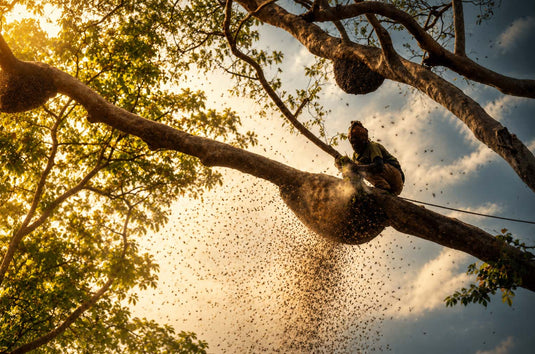
Wild collection demands intense teamwork and careful preparation. Depending on the terrain, hunters assemble bamboo ladders, specialized collection baskets, and ropes crafted from natural fibers to scale massive heights. Each member has a distinct role-some handle the safety ropes, others prepare the calming smoke, while the most experienced climbers ascend to interact directly with the hive.

The Role of Smoke in Calming the Hive
One of the most important elements of the process is the use of smoke. Smoke is never intended to harm or suffocate the bees. Traditional hunters make cool, natural smoke by burning dry leaves, grass, and forest bark. This smoke temporarily disrupts the bees' chemical alarm signals, encouraging them to move to the lower sections of the comb and allowing gatherers to harvest safely while keeping hive stress low.
Climbing & Assessing Hive Maturity
The most physically demanding phase involves scaling trees or descending steep mountain cliffs where Apis dorsata bees prefer to build their enormous combs. Once at the hive, gatherers do not automatically harvest. They carefully inspect the structural balance of the comb to ensure the honey is fully mature and that the colony is strong enough to handle a harvest without being disrupted.
Sustainable Sourcing & Raw Extraction
Core Sustainable Honey Collection Practices
Ethical honey collection focuses on preserving the bee population while utilizing forest resources responsibly. Gatherers do not remove the entire hive; instead, they make precise cuts to harvest only the top honey-rich section of the comb. The vital lower brood chambers-housing the developing larvae and the queen bee-are left completely untouched. This allows the colony to quickly rebuild and continue thriving across seasons.
Traditional Extraction & Quality Control
Once gathered, the combs are handled using minimal, traditional methods. The honeycomb blocks are pressed gently, letting the liquid honey drain naturally via gravity. It is then filtered through a coarse cotton cloth to remove large wax fragments while retaining the microscopic wild pollen grains, live enzymes, and protective propolis tracks that give raw forest honey its exceptional biological value.
Purity Assurance Profile: To guarantee absolute quality, responsible producers avoid high-temperature processing and conduct independent laboratory testing to confirm moisture levels, botanical markers, and the complete absence of added syrups.
Experience Certified Raw, Lab-Tested Wild Forest Purity
Our forest honey is never heated, micro-filtered, or adulterated with sugar blends.
Secure Your Pure Honey Jar
Ecological Significance and Challenges
Forest honey harvesting remains one of the most physically demanding food-gathering activities practiced today. Gatherers regularly brave environmental hazards, steep terrain, unpredictable weather, and defensive stings from wild colonies. Yet, when practiced responsibly, this custom provides vital economic incentives for native communities to protect standing forests from logging and industrial conversion. Supporting sustainable honey hunters preserves both ancient ecological knowledge and wild pollinator biomes.

The harvesting of forest honey is a remarkable process that connects people directly to the rhythms of nature. From locating wild bee colonies deep within forests to carefully collecting mature honey while preserving the colony’s future, every stage reflects a delicate balance between human use and environmental stewardship.
Traditional honey hunters serve as guardians of both ancient knowledge and ecological sustainability. Their expertise allows consumers to enjoy one of nature’s most complex and nutritious foods while supporting the conservation of forests and pollinators.
Understanding how forest honey is harvested reveals why authentic forest honey remains one of the world’s most valuable natural products. It is not simply honey-it is the result of thriving ecosystems, resilient wild bees, and generations of people working respectfully with nature rather than against it.
Frequently Asked Questions (FAQs)
1. Does the harvesting smoke harm the wild bee colonies?
No. Traditional honey hunters use cool, controlled smoke made from natural forest leaves and twigs to temporarily disrupt bee communication and mask alarm pheromones. This gently calms the bees without harming them or affecting the honey quality.
2. Why is wild forest honey more expensive than box-farmed honey?
Wild forest honey commands a premium due to the immense physical risks, specialized climbing labor, low seasonal extraction volumes, and extensive purity testing required to harvest safely from high forest canopies and cliffs.
3. How do honey hunters ensure the bees don't abandon the hive?
Sustainable harvesting involves cutting away only the specific top sections of the comb containing mature honey. The lower brood chambers, the queen bee, and the primary hive architecture are left completely intact so the colony can fully recover.
Bring Home the Pure Essence of the Wild Forest
Experience 100% raw, sustainably gathered honey from India's untamed woodland canopies.
Order Authentic Forest HoneyWant to learn more about wild honey sourced directly from India's forests?
Explore our Ultimate Guide to Forest Honey in India: Benefits, Purity, Harvesting & Uses to understand how forest honey is collected, how it differs from regular honey, and the key signs of authentic, unprocessed forest honey.
Read the Ultimate Guide to Forest Honey in India →