How to Test Honey for Purity: Understanding C3 & C4 Sugar Adulteration
A clear, consumer-friendly guide to how sophisticated sugar adulteration works, what laboratory tests can reveal, and how to make more informed honey choices.
For anyone who cares about the honey they bring home, understanding purity means looking beyond colour, texture and sweetness. Modern adulteration can be sophisticated, which is why reliable honey testing matters. In the global honey trade, economic adulteration has evolved into a highly sophisticated branch of illicit industrial chemistry. The days of simple water dilution or crude corn syrup addition are long gone. Today, the market faces chemically engineered designer syrups specifically manufactured to mimic the physical property parameters, carbohydrate balances, and enzyme matrices of pure honey.
Simple home observations can be useful, but they cannot reliably identify every form of sugar adulteration. This guide explains the science behind C3 and C4 sugars, why some adulterants are easier to detect than others, and which laboratory methods offer stronger evidence. This comprehensive technical guide breaks down the structural differences between C3 and C4 sugar adulteration, how these syrups are engineered to bypass legacy testing methods, and the advanced laboratory analytics required to isolate them.
1. The Core Scientific Premise: Carbon Fixation Pathways
To understand how industrial food fraudsters manipulate sugars, we must first look at plant biology. All plants synthesize glucose and fructose from carbon dioxide and water through photosynthesis. However, depending on the plant’s evolutionary adaptation, they utilize different enzymatic mechanisms to capture carbon atoms from the atmosphere. These mechanisms are classified into distinct carbon fixation pathways.
The two primary pathways that dominate agricultural sugar production are the Calvin-Benson (C3) pathway and the Hatch-Slack (C4) pathway.
The C3 Carbon Pathway
Plants that employ the C3 pathway utilize an enzyme called Rubisco to catalyze the initial step of carbon fixation. This chemical reaction creates a 3-carbon molecular structure (3-phosphoglycerate) as its baseline building block.
- Botanical Examples: The vast majority of honey-producing trees, wild shrubs, and agricultural flower blooms belong to the C3 category.
- Commercial Sugar Counterparts: Sugar beets, rice, wheat, and cassava are all C3 plants.
The C4 Carbon Pathway
Plants utilizing the C4 pathway rely on the enzyme PEP carboxylase to capture carbon dioxide. This mechanism is an evolutionary adaptation designed to optimize water efficiency in hot, arid conditions. It produces a 4-carbon compound (oxaloacetate) before channeling it into standard sugar processing loops.
- Botanical Examples: Tropical grasses and heavy agricultural monoculture grains. Honeybees do not naturally target these crops for nectar collection.
- Commercial Sugar Counterparts: Sugar cane, corn, sorghum, and millet are prominent C4 plants.
Understanding Plant Pathways & Honey Authenticity
Because honeybees forage almost exclusively on nectar-secreting flowering plants, pure honey naturally retains a distinct C3 plant profile. When foreign C4 or engineered C3 sugars are blended into honey batches, they disrupt the natural equilibrium of carbohydrates, proteins, and trace enzymes—creating molecular deviations that advanced laboratory equipment can track.
2. The Isotope Signature: δ13C Values Explained
Because the enzymes in C3 and C4 pathways process carbon isotopes at slightly different speeds, they take in different ratios of stable carbon isotopes from the air. Specifically, they alter the ratio between Carbon-12 (12C, the dominant stable isotope) and Carbon-13 (13C, a rarer stable isotope).
When measuring these elements via stable isotope ratio mass spectrometry (IRMS), scientists use parts-per-thousand (per mil, or ‰) differences relative to an international standard. This value is written as δ13C.
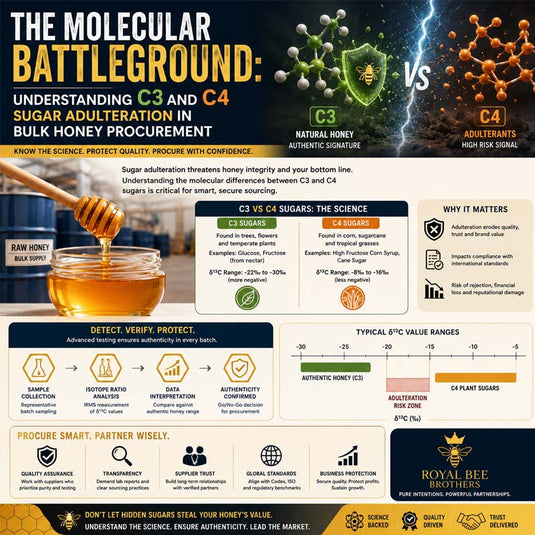
- Natural C3 Plant Profiles: Because honeybees gather nectar from C3 trees and wild floral blossoms, authentic natural honey carries a distinct C3 isotopic signature. The typical δ13C values for pure honey fall into a precise range of -22‰ to -33‰.
- Industrial C4 Sugar Profiles: Crops like corn and sugar cane are heavily processed into cheap high-fructose syrups. Because of their distinct C4 pathway enzyme structure, their processed sugars yield a much heavier δ13C reading, tracking tightly between -10‰ and -20‰.
Because of this clear, wide divergence in isotopic signatures, analytical labs can spot C4 adulterants by running the honey through basic carbon isotope analysis.
3. The History: How C4 Syrups Exploited the Market
During the early waves of industrial honey adulteration, suppliers realized they could drastically cut their manufacturing costs by mixing raw honey with High-Fructose Corn Syrup (HFCS) or liquid cane sugar invert syrups. These C4 plant derivatives matched honey’s fluid profile, texture, and sweetness perfectly at a fraction of the cost.
To stop this economic fraud, international regulatory bodies established the AOAC 998.12 official method. This protocol utilizes Stable Isotope Ratio Analysis (SIRA) to run a comparative carbon isotope check on a single sample:
- The lab measures the δ13C value of the whole honey sample.
- The lab extracts the internal protein fractions from that same sample and measures its specific isotope score. Honey’s natural protein matrix comes directly from the bee and the target pollen, meaning it holds an immutable, pure C3 signature that cannot be replicated by added factory sugars.
- The calculation looks at the mathematical difference between the two values:
If the added sugar syrup comes from a C4 plant (corn or cane), it pulls the whole honey value closer to the -10‰ range, while the isolated protein value stays safely in the C3 range. If the difference (Δδ13C) exceeds a critical parameter threshold of 1.0‰, the batch is flagged as adulterated. This analytical protocol effectively shut down crude, unchecked C4 corn and cane syrup fraud across major global ports.
4. The Next Evolution: The Rise of C3 Sugar Fraud
As C4 tracking systems became standard procedure at international customs terminals, industrial sugar adulterators evolved. They realized that if they utilized sugar sources that shared the exact same C3 carbon fixation pathway as natural honey flowers, the resulting factory syrups would match the honey's δ13C value exactly.
This realization led to the development of highly processed, clarified syrups derived from rice, wheat, sugar beets, and starch-rich cassava.
Because these industrial C3 syrups sit perfectly within the same -22‰ to -33‰ range as pure honey, traditional SIRA and AOAC protein comparison checks show a difference of zero. To a basic carbon isotope mass spectrometer, an intentional 40% blend of clarified rice syrup looks identical to pure wild honey.
Furthermore, industrial processors advanced their techniques to eliminate residual complex starches, adjust carbohydrate ratios to mimic natural fructose-to-glucose parameters, and neutralize trace minerals. This modern strategy produces an almost invisible adulterant that can easily bypass standard laboratory checks unless advanced multi-dimensional screening is deployed.
Enzyme Conversion & Synthetic Syrup Refinement
Modern industrial syrup manufacturers employ targeted enzymatic treatments to convert raw grain starches into liquid sugar. Industrial beta-amylases, fungal invertases, and transglucosidases are applied to break long glucose chains into precise fructose and glucose balances. Subsequent resin filtration removes unwanted thermal markers, colors, and plant aromas, producing neutral syrups designed specifically to bypass legacy food safety checks.
5. Why Adulteration Is Difficult to Spot at Home
The challenge for everyday honey buyers is that many sophisticated syrups are designed to resemble honey in sweetness, colour and texture. A jar can look perfectly normal while still requiring laboratory analysis to establish whether foreign sugars have been added.
This is also why natural variation should not automatically be mistaken for adulteration. Floral source, season, moisture, temperature and storage can influence honey's colour, aroma, flow and crystallisation.
6. Advanced Honey Testing: How Laboratories Detect Adulteration
For consumers seeking stronger assurance, laboratory testing can go beyond simple visual checks. Different analytical methods are designed to detect different forms of adulteration, so no single test should be presented as universal proof.
Nuclear Magnetic Resonance (NMR) Honey Testing
NMR spectroscopy is the single most powerful tool for capturing sophisticated food fraud. Instead of testing isolated elements sequentially, high-resolution NMR non-destructively screens the entire molecular matrix of the honey sample simultaneously.
- Advanced Pattern Recognition: The resulting NMR spectrum maps hundreds of internal components, including organic acids, amino acids, and minor sugar fractions. This spectrum is compared against a comprehensive database of verified authentic global honeys via advanced pattern recognition algorithms.
- Syrup Adulteration Markers: NMR instantly isolates specific foreign metabolic processing markers (such as 2-acetylfuran-3-glucopyranoside found in industrial rice syrups) that are completely absent in pure, bee-processed nectar. It catches both C3 and C4 syrup modifications down to low blending percentages while simultaneously validating the batch's stated botanical and geographical origin.
Liquid Chromatography-Isotope Ratio Mass Spectrometry (LC-IRMS)
While traditional SIRA measures the total bulk carbon mix, LC-IRMS couples a high-performance liquid chromatography separation system directly with an isotope mass spectrometer.
- Monosaccharide Tracking: This setup physically separates individual sugar molecules (fructose, glucose, sucrose, and maltose) before measuring the specific carbon isotope ratio of each component independently.
- Invert Sugar Signals: If a supplier attempts to introduce chemically split invert beet sugar or highly refined C3 corn starches, the isotope ratios between the individual isolated sugars will diverge noticeably, exposing the addition.
High-Performance Anion-Exchange Chromatography (HPAEC-PAD)
Industrial starch hydrolysis processes (like turning rice or corn starch into liquid sugar) always leave behind trace quantities of complex sugars called oligosaccharides. HPAEC-PAD screens specifically for these foreign oligosaccharide profiles and thermal markers. The presence of specific carbohydrate peaks (like maltotriose or higher maltodextrin chains) confirms that the sample has been blended with industrially modified starch syrups, even if the bulk properties appear clean.
7. How Different Tests Help Detect Adulteration
For readers who want to understand what laboratory analysis can reveal, this technical matrix summarizes how different adulterants respond to modern laboratory tests:
| Analytical Parameter Evaluation | Target Adulterant Matrix | Primary Test Method | Detection Target / Technical Marker | Risk Mitigation Level |
|---|---|---|---|---|
| C4 Carbon Sugar Influx | High-Fructose Corn Syrup (HFCS), Sugarcane Invert Syrups | EA-IRMS / SIRA (AOAC 998.12) | Mathematical difference between whole honey and internal protein (Δδ13C > 1.0‰) | 🟢 Complete Defense (Legacy Standard) |
| C3 Carbon Sugar Influx | Clarified Rice Syrup, Wheat Syrup, Cassava Starch Derivatives | NMR-Based Screening / HPAEC-PAD | Specific foreign metabolic markers, trace industrial processing residues, and foreign oligosaccharide carbohydrate peaks | 🟢 Complete Defense (Modern Standard) |
| Invert Sugar Alterations | Acid-Hydrolyzed Beet Sugar, Chemically Split Sucrose | LC-IRMS / LC-MS/MS | Carbon isotope ratio variances between independent separated monosaccharides (Fructose vs. Glucose) | 🟡 High-Efficiency Defense |
| Exogenous Enzyme Activity | Added Industrial Invertase, Amylases, or Foreign Beta-Glucosidases | Targeted Enzyme Profiling | Excessive, unnatural enzyme balances or presence of heat-stable industrial enzymes used during factory syrup processing | 🟡 High-Efficiency Defense |
| Thermal Degradation / Alteration | Overheating, Flash-Pasteurization, Long-Term Poor Warehousing | Physicochemical Profiling (COA Audits) | Hydroxymethylfurfural (HMF) levels exceeding 40 mg/kg paired with a significant drop in natural diastase enzyme activity | 🟢 Complete Defense |
8. A Practical Purity Checklist for Honey Buyers
While no single visual or kitchen test can prove honey purity, these four habits can help you make a more informed purchase:
- Look for meaningful quality information: Do not rely on standard bulk density or moisture sheets. Look for clear batch information, transparent sourcing, and credible quality documentation when it is available.
- Prefer traceable, clearly identified products: Do not treat a small visual sample as conclusive proof. For serious verification, independent laboratory testing of the actual product is more meaningful than appearance alone.
- Understand what testing can and cannot show: Ask which adulteration markers the laboratory method can detect and understand the limits of the reported result.
- Choose transparency over exaggerated claims: Choose products with clear labeling, traceable sourcing information and realistic purity claims rather than relying on appearance or marketing language alone.
Explore More About Honey Purity & Natural Honey
Continue exploring Royal Bee Brothers resources on honey testing, natural variation, forest honey and choosing honey with greater confidence through our curated resource hub:
Why Transparency Matters When Choosing Honey
Honey naturally varies with floral source, season, geography and storage. A trustworthy buying decision therefore starts with transparent information rather than a single visual “purity test.” Look for clear product details, traceable sourcing where available, and claims that can be supported by appropriate testing.
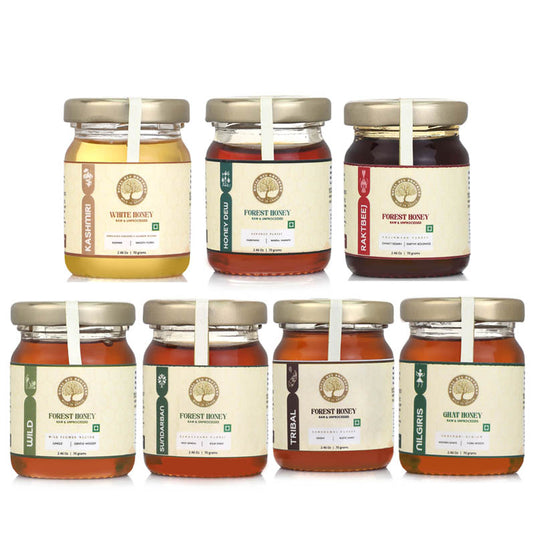
At Royal Bee Brothers, our focus is on bringing distinctive forest-sourced honey and natural products closer to consumers while helping them understand what makes each variety different. Explore our Forest Honey Collection and learn more about honey's natural character through our guides.
Discover Honey With Character
Explore forest honey varieties shaped by India's diverse landscapes, floral sources and seasons.
Explore Forest Honey →