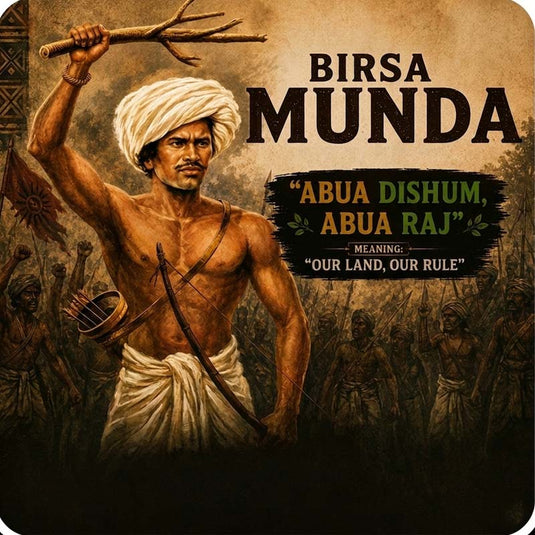
The Sovereign of the Soil: Bhagwan Birsa Munda and the Ulgulan Uprising
The history of India’s march toward independence is frequently told through the lens of mainstream urban movements, legislative battles, and subcontinent-wide campaigns. Yet, some of the most fierce, unyielding, and philosophically profound resistance against colonial subjugation emerged from the deep, ancient heartlands of India’s tribal territories. At the absolute apex of this ancestral resistance stands a young man who, in a brief lifespan of just twenty-five years, fundamentally altered the geopolitical landscape of the Chotanagpur plateau and transformed from a mortal revolutionary into a divine archetype.
He is Bhagwan Birsa Munda—also revered across the subcontinent as Dharti Aba, the Father of the Earth.
Born on November 15, 1875, in the remote hamlet of Ulihatu in modern-day Jharkhand, Birsa Munda’s life is not merely an individual biography. It is an epic chronicle of indigenous survival, a masterclass in grassroots mobilization, a radical spiritual renaissance, and a devastating critique of both foreign imperialism and domestic feudalism. To truly understand the magnitude of his legacy is to understand the sacred relationship between the Adivasi (the indigenous peoples) and the forest—an ecosystem where land ownership was never a matter of commercial deeds, but an unseverable spiritual covenant.
I. The Sacred Economy of the Mundas: The Khuntkatti System
To understand why the spark of rebellion caught fire so explosively in the late nineteenth century, one must first look at the traditional socio-economic framework that sustained the Munda tribe for centuries before the arrival of European administrators.
Collective Ownership
No individual property deeds; land belongs entirely to the communal lineage.
Ecological Balance
Sustainable clearing of forest land for survival while keeping the ecosystem pure.
The bedrock of Munda civilization was an agrarian framework known as the Khuntkatti system. In standard terms, Khuntkatti translates to the joint or collective ownership of land by a specific clan (khunt) that had originally cleared the virgin forests to establish a settlement. Unlike the individualistic, capital-driven property structures of Western Europe or post-medieval mainland Asia, the Mundas did not view the earth as a liquid asset to be bought, mortgaged, subdivided, or sold.
- The Lineage of the Axe: The land belonged unconditionally to the ancestral lineage. Every family within the commune held an inalienable right to till the soil, gather wild honey, collect fallen timber, and pasture livestock safely.
- Sovereign Communalism: Wealth was measured not by individual accumulation, but by the collective resilience, health, and spiritual harmony of the entire village.
- The Spiritual Canopy: The forest was populated by Bongas (spirits of nature and ancestors). To pollute the land with greed or to parcel it out for private gain was seen as a profound violation of natural and cosmic law.
For generations, this pristine system ensured that poverty, destitution, and landlessness were virtually non-existent within Munda territory. The village chief (Munda) and the religious head (Pahan) operated as custodians of the peace, maintaining an equilibrium that perfectly balanced human need with environmental preservation.
II. The Encroachment of the Dikus: Structural Violence and Colonial Law
This ancient equilibrium was shattered when the British East India Company, and subsequently the British Crown, extended its administrative grip into the Chotanagpur division. Operating under a philosophy of maximizing land revenue to fund imperial expansion, the British colonial apparatus viewed the communally managed forests of Jharkhand through a purely extractive lens.
To the British, untaxed communal land was a legal anomaly and an economic waste. They systematically dismantled the Khuntkatti framework by introducing a series of legislative changes that effectively criminalized the traditional lifestyle of the indigenous peoples.
The Mechanics of Subjugation
The implementation of the Permanent Settlement Act and the introduction of complex British jurisprudential codes transformed the tribal landscape overnight. The colonial administration introduced a class of intermediaries to enforce aggressive tax collections:
│
& traditions and security mechanisms broken
↓
[ THE DIKUS (Outsiders) ] → Landlords (Zamindars), exploitative moneylenders, and traders.
│
& structural displacement of ancestral identity
↓
[ THE ADIVASI POPULATION ] → Stripped of ancestral land privileges, forced into bonded labor.
The word Diku became an emotionally charged term within the tribal psyche. It did not merely mean an outsider; it signified an existential threat—a parasite that drained the vitality of the forest ecosystem.
- The Traps of the Usurer: Because the British demanded land revenue exclusively in hard cash rather than a share of the actual harvest, the Mundas were forced to turn to non-tribal moneylenders (Mahajans) to pay their taxes.
- Exorbitant Interest Rates: These moneylenders charged compound interest rates that routinely exceeded 100% or even 200% annually.
- The Loss of the Soil: When a tribal farmer inevitably defaulted on a single payment, the newly established British courts—operating in languages the tribals did not understand and requiring written deeds they did not possess—summarily stripped the farmer of his ancestral plot and handed it directly to the moneylender.
The Tragedy of Bonded Labor (Beth Begari)
Within a single generation, proud, independent custodians of the forest were converted into landless peasants, tenants-at-will, and indentured servants on their own historical soil. They were subjected to Beth Begari—a brutal system of forced, uncompensated labor where tribal men and women were compelled to build roads, clear forests, and harvest fields for the landlord class under threat of severe physical torture.
Simultaneously, the colonial government enacted sweeping forest conservation laws that restricted the tribal population's access to forest produce. Suddenly, gathering wild honey, cutting firewood, or collecting wild roots for medicine became punishable criminal offenses against the Crown. The indigenous communities felt isolated, deeply exploited, and discarded within their own homeland.
III. Early Life, Disillusionment, and Spiritual Awakening
It was against this background of systemic degradation that Birsa Munda was born in Ulihatu. Due to the extreme poverty of his family, he moved frequently during his childhood, spending significant time in villages like Chalkad.
Recognizing the young boy’s exceptional intelligence, sharp memory, and charismatic presence, his family enrolled him in the German Evangelical Lutheran Mission School in Chaibasa. To enter the school, Birsa conformed to the institutional mandates of the time and converted to Christianity, adopting the name Birsa David.
Mission Education
Chaibasa; studied Western philosophy, tribal history, and comparative religious frameworks.
Vaishnav Influence
Anand Panwar's teachings; adopted the sacred thread and strict vegetarianism.
Indigenous Roots
Deep reconnection to Munda cosmology and the pure spirituality of the forest landscape.
The Awakening at Chaibasa
Birsa's years in Chaibasa were critical to his intellectual evolution. Here, he gained mastery over Western concepts of law, history, and governance. He read the Bible deeply, but he also listened intently to the intense political debates surrounding the ongoing tribal grievances against colonial authorities.
He gradually noticed a profound contradiction in the missionary presence: while the missionaries offered health care and basic literacy, they frequently synchronized their work with the colonial administration. They openly criticized the ancestral customs of the tribal communities and urged them to abandon their cultural traditions. When missionaries failed to protect tribal land rights from landlord encroachment, Birsa reached a point of deep disillusionment.
In a bold act of defiance for a teenager, he openly criticized the missionaries, left the school, renounced Christianity, and returned to his traditional roots.
The Synthesized Faith: Birsait
Following his departure from Chaibasa, Birsa spent several formative years under the spiritual guidance of a Vaishnav teacher named Anand Panwar. During this period, he immersed himself in epic literature, adopted the sacred thread, and practiced strict vegetarianism.
This journey led to a profound spiritual experience in the mid-1890s. Birsa emerged not merely as a political organizer, but as a visionary prophet. He synthesized elements from his diverse spiritual background—the strict monotheism of Western thought, the purity and non-violence of Vaishnavism, and the deep, earth-centered animism of Munda cosmology—to establish an entirely new socio-religious path: the Birsait faith.
He preached a message of radical purification:
- The Rejection of Sorcery: He urged the Mundas to abandon superstitious fears, witchcraft, animal sacrifices, and expensive rituals that drained their financial resources.
- Absolute Monotheism: He commanded his followers to worship a single supreme deity—Singbonga (the Spirit of Light or the Sun God).
- Ethical Living: He mandated strict abstinence from alcohol, a return to cleanliness, and a lifestyle centered on moral integrity.
Word of a young prophet with healing hands and mesmerizing eloquence swept like wildfire through the hills of Chotanagpur. Thousands of people from the Munda, Oraon, and Kharia communities abandoned their old practices to join the Birsait movement. They traveled long distances to Chalkad just to catch a glimpse of the young leader they now called Dharti Aba (Father of the Earth).
IV. The Ideology of Reclaiming Dignity: The Five Immutable Truths
Birsa Munda understood that spiritual renewal was the vital first step toward total political liberation. He recognized that an oppressed people must first reclaim their internal dignity before they can successfully confront an empire. To unify the highly fragmented tribal clans, he summarized his philosophical, social, and political principles into five powerful declarations that challenged the legitimacy of British rule:
1. The Proclamation of Absolute Sovereignty
"Abua raj seter jana, maharani raj tundu jana."
This historic call translated directly to: "Let the kingdom of the Queen be ended and our kingdom be established." It was an incredibly bold political declaration. Birsa did not petition for minor administrative modifications or tax relief; he asserted that the British Crown had absolutely zero legal or moral authority over the soil of Chotanagpur. He envisioned a completely self-governing tribal republic (Abua Raj) where indigenous councils would hold absolute authority over their own political future.
2. The Inalienable Right to Terroir
"We are the sons of the soil; we have our rights to the land."
This core principle directly challenged the Western legal concept of private property, which the British used to seize ancestral lands. Birsa argued that the right of the Adivasi to the forest was a sacred birthright given by Singbonga, which could never be invalidated by a paper deed issued by an imperial court. This statement became an early foundation for modern indigenous land-rights movements across the globe.
3. The Uncompromising Call to Action
"Do or Die."
Decades before this phrase was popularized across mainland India during the Quit India Movement, Birsa Munda used it to emphasize the critical, existential nature of the tribal struggle. He made it clear to his followers that the fight against the Dikus and the British Empire was not a casual political dispute; it was a matter of sheer cultural survival. To submit to Beth Begari (forced labor) was worse than death; therefore, risking one's life for total liberation was the only honorable choice left.
4. The Prophecy of Restoration
"The golden age is coming back."
To inspire a community broken by generations of structural poverty, Birsa spoke beautifully of a utopian past and future—a Satyayug (Golden Age). He painted a vivid picture of an era before the arrival of the Dikus, when the rivers ran unpolluted, the granaries were full, and the Mundas lived in peace, free from exploitation. This vision served as a powerful motivational force, assuring his followers that their sacrifices would directly lead to a proud and dignified future.
5. Radical Cultural Autonomy
"Let us embrace our own ways and reject the ways of the outsiders."
Birsa identified cultural assimilation as a subtle but highly dangerous weapon of colonial control. He warned his people that adopting the consumerist habits, legalistic deceits, and divisive social hierarchies of the Dikus would inevitably erode the core strength of tribal society. He advocated for complete educational, social, and psychological self-reliance, encouraging his followers to take pride in their language, ancestral customs, and communal values.
V. The Ulgulan: Organizing the Great Tumult
By 1895, the spiritual transformation led directly to an open political challenge. Birsa Munda began touring villages extensively, utilizing traditional festivals, weekly markets (haats), and clandestine night meetings in the dense forests to build a highly structured revolutionary network. This movement became known as the Ulgulan—The Great Tumult.
The organizational sophistication of the Ulgulan was remarkable. Birsa set up a dual leadership structure:
- The Spiritual Wing: Promoted the clean Birsait lifestyle, maintained community morale, and handled logistics and communications.
- The Military Wing: Directed by highly trusted commanders like Gaya Munda and Donka Munda, this wing focused on manufacturing traditional weapons, mapping terrain, and training specialized guerrilla units.
Instead of relying on modern firearms, the Mundas turned their traditional hunting tools into effective weapons of war. They crafted high-tension bows from flexible bamboo, forged iron-tipped arrows, sharpened traditional battle-axes (tangi), and gathered smooth river stones to use with slingshots.
To maintain secrecy away from British intelligence, the movement used a system of silent signals. Sal tree twigs were passed quietly from village to village across Chotanagpur, serving as an undeniable call-to-arms that summoned village chiefs to secret planning assemblies located deep within the hills.
VI. Guerilla Warfare in the Jungles: Chronology of the Conflict
The active phase of the Ulgulan erupted violently in December 1899, carefully timed to coincide with Christmas Eve. Birsa made a conscious decision to strike when the British administrative and military apparatus would be distracted by holiday celebrations.
The Initial Uprising
Coordinated attacks broke out simultaneously across a vast territory, including Ranchi, Khunti, Tamar, and Sarwada. The primary targets were highly strategic symbols of colonial oppression: British police stations (thanas), government offices, colonial record houses, and the luxurious estates of wealthy Zamindars.
The guerrilla units moved swiftly through the dense jungle paths with incredible speed. They would launch rapid, unexpected ambushes on colonial positions and vanish back into the wilderness before British reinforcements could react. Birsa’s forces deliberately avoided harming innocent civilians, focusing their efforts entirely on dismantling the infrastructure of the colonial state and the property of the exploiting landlords.
The Tragedy at Dombari Hill
Alarmed by the rapidly growing scale of the uprising, the British administration dispatched heavy military reinforcements, including the 6th Bengal Infantry and specialized police detachments equipped with modern long-range rifles and early Maxim machine guns.
The conflict reached its tragic climax on January 9, 1900, at Dombari Hill (located near Khunti). A massive assembly of tribal freedom fighters—including women, children, and the elderly—had gathered on the hill under the leadership of Birsa Munda. The British forces quietly surrounded the hill, took up dominant high-ground positions, and opened fire on the crowded gathering without warning.
The Mundas fought back with incredible courage. Tribal women, led by figures like Gaya Munda’s wife, Maki Mui, defended their positions using kitchen axes and slingshots against a barrage of modern gunfire. The red soil of Dombari Hill was stained with the blood of hundreds of tribal fighters who chose to stand their ground rather than surrender. Despite the heavy losses, the defense of Dombari Hill allowed Birsa Munda and his inner circle of commanders to safely slip through the British lines and retreat deep into the safety of the surrounding rocky terrain.
VII. Captivity, Martyrdom, and the Mysterious End
Following the events at Dombari Hill, the British government launched an intensive manhunt across the region. They placed a substantial cash bounty on Birsa Munda’s head, an immense sum at the time that represented incredible wealth to impoverished villagers struggling through a severe famine.
The Betrayal at Jamkopai
For months, the local population refused to break their silence, choosing to endure severe police interrogation and village raids rather than betray Dharti Aba. However, the pressure of prolonged hunger and structural temptation eventually took its toll. On February 3, 1900, acting on a secret tip provided by a small group of individuals lured by the government reward, British authorities surprised Birsa Munda while he was asleep in his hidden camp within the Jamkopai Forest in Chakradharpur.
As news of his arrest spread, thousands of emotional tribal citizens lined the roads, watching in silence as their young leader was marched in heavy chains to the Ranchi Jail. Even in captivity, Birsa remained calm and dignified, refusing to answer his captors' questions or compromise his revolutionary ideals.
A Controversial Passing
The legal trial of Birsa Munda and his 400 captured followers began inside the jail walls. However, before a formal judicial verdict could be delivered, the young leader's health took a sudden, catastrophic turn. On June 9, 1900, at the young age of twenty-five, Birsa Munda passed away inside his isolation cell.
The colonial medical officers quickly attributed his death to an acute case of cholera. However, this explanation was met with deep skepticism by the public. Birsa had shown no prior symptoms of the disease, and he was known for his exceptional physical fitness and vitality. Suspecting foul play, rumors spread that he had been secretly poisoned by colonial authorities who feared that a public execution would turn him into an eternal martyr and reignite the rebellion. To prevent his grave from becoming a sacred shrine for future uprisings, the British authorities hurriedly cremated his body behind the prison walls and scattered his ashes in an unmarked location near the Distillary River in Ranchi.
VIII. The Lasting Impact: Legacies in Law and National Memory
While the British managed to physically suppress the Ulgulan movement, they quickly realized that returning to the old, unchecked ways of exploitation was impossible. The rebellion had proven that ignoring tribal grievances risked triggering a permanent cycle of violent conflict in a resource-rich region.
The Chotanagpur Tenancy Act (CNT) of 1908
The most significant and lasting legal consequence of Birsa Munda's struggle was the drafting and passage of the Chotanagpur Tenancy Act of 1908. This historic piece of legislation completely transformed land administration in tribal India:
- The Preservation of Heritage: It legally recognized and restored the unique, community-led Khuntkatti land ownership system for the Munda clans.
- The Restriction of Land Transfers: It placed a strict, permanent ban on the transfer of tribal land to non-tribal individuals (Dikus).
- A Legal Protection Shield: It mandated that if a tribal landowner wished to sell or transfer property, it could only be done to another tribal individual within the same police station jurisdiction, protecting ecosystems from corporate exploitation.
The CNT Act remains a powerful legal shield for the indigenous populations of Jharkhand, protecting them from total land alienation from powerful corporate interests and real estate speculation. It stands as an enduring, legally binding monument to the young revolutionary's campaign.
IX. Comparative Analysis: The Unique Brilliance of Birsa Munda
To fully appreciate Birsa Munda’s unique place in history, it is valuable to compare his leadership style with other major anticolonial movements across the globe:
| Dimension of Leadership | Mainstream National Movement | Global Indigenous Struggles | The Ulgulan of Birsa Munda |
|---|---|---|---|
| Primary Combatants | Urban intelligentsia, lawyers, and elite landowners. | Traditional tribal warriors and military chiefs. | A completely unified community of men, women, and children. |
| Core Ideology | Constitutional reforms and legislative representations. | Territorial defense against expanding frontier borders. | A holistic synthesis of spiritual purity and total sovereignty. |
| Strategic Methods | Editorial writing, formal debates, and economic boycotts. | Traditional, open battlefield engagements. | Highly sophisticated jungle guerrilla warfare and civil autonomy. |
| Long-Term Impact | Gradual, evolutionary legislative changes over decades. | Relocation to reservations or forced containment. | The landmark Chotanagpur Tenancy Act of 1908. |
X. Echoes in the Present: The Relevance of the Birsait Path
The issues that Bhagwan Birsa Munda fought against over a century ago—land displacement, cultural erosion, and economic marginalization—remain deeply relevant in modern conversations around development and indigenous rights.
- Environmental Stewardship: In an era defined by climate change and industrial over-extraction, the core Birsait philosophy—treating the earth as a living, sacred system rather than a resource to be exploited—serves as a timeless guide for sustainable living and preserving the natural purity of forest products.
- Sovereign Local Governance: Modern Indian legislative initiatives, such as the PESA (Panchayats Extension to Scheduled Areas) Act, which grants local tribal councils authority over community resources, directly reflect Birsa's original vision of Abua Raj.
- National Recognition: Today, his birth anniversary on November 15 is celebrated nationwide as Janjatiya Gaurav Divas (Tribal Pride Day). This serves as a powerful reminder that the story of India's independence is incomplete without acknowledging the immense contributions of its tribal heroes.








1 comment
wow