Apis Dorsata vs Apis Mellifera Honey: Understanding the Differences Between Wild Forest Honey and Commercial Honey
Honey has been valued for thousands of years as a natural sweetener, traditional remedy, and nutrient-rich food. However, not all honey is the same. The species of bee producing the honey, the floral source, harvesting method, and environmental conditions significantly influence its taste, nutritional profile, medicinal properties, and market value.
Among the numerous honey-producing bee species worldwide, Apis dorsata (Giant Honey Bee or Rock Bee) and Apis mellifera (Western Honey Bee) are two of the most recognized. While both produce high-quality honey, they differ substantially in behavior, habitat, honey composition, harvesting techniques, and commercial importance.
| Feature | Apis Dorsata (Wild Forest) | Apis Mellifera (Commercial) |
|---|---|---|
| Bee Nature | Giant Rock Bee (Wild, non-domesticated) | Western Honey Bee (Managed, domesticated) |
| Nesting & Habitat | Massive single combs on cliffs & tall forest trees | Movable wooden frames in managed apiaries |
| Flavor Profile | Strong, robust, complex earthy undertones | Mild to moderate sweetness, highly consistent |
| Sourcing Profile | Traditional, sustainable forest community foraging | Centrifugal extraction, large-scale crop farming |
What Is Apis Dorsata?
Apis dorsata, commonly known as the Giant Honey Bee or Rock Bee, is native to South and Southeast Asia, including India, Nepal, Sri Lanka, Thailand, and Indonesia. These bees are among the largest honeybee species in the world.
Unlike managed honeybee colonies, Apis dorsata is a wild species that builds massive single-comb nests on cliffs, tall trees, rock faces, and forest canopies. Their colonies can contain tens of thousands of bees and are known for their highly defensive behavior.

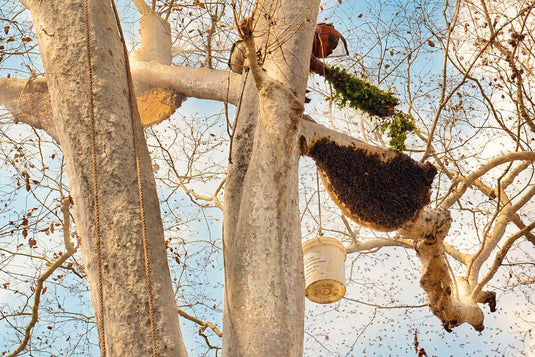
A pristine, single-comb nest of wild Apis dorsata high up in the primary forest canopy.
Key Characteristics of Apis Dorsata
- Wild and non-domesticated species
- Builds large exposed single combs
- Found primarily in deep forest reserves and wilderness areas
- Yields premium raw wild forest honey
- Vital pollinator of indigenous forest ecosystems
- Characterized by natural seasonal migration patterns
What Is Apis Mellifera?
Apis mellifera, known as the Western Honey Bee, is the most widely managed honeybee species globally. Native to Europe, Africa, and Western Asia, it has been introduced worldwide for commercial honey production and crop pollination.
Modern box-hive beekeeping relies heavily on Apis mellifera due to its relatively docile temperament, predictable honey yield, and high adaptability to artificial movable apiary hives.
Key Characteristics of Apis Mellifera
- Easily managed within modern wooden beehives
- High, efficient honey production capacity
- Adaptable to diverse temperate and agricultural climates
- Essential for large-scale agricultural crop pollination
- Produces distinct monofloral (single-source) and multifloral honey varieties
- Formulates the foundation of commercial honey farming
Differences in Habitat and Foraging Behavior
Apis Dorsata: Deep Forest-Based Foraging
Apis dorsata exclusively gathers nectar from deep forest wildflowers, ancient medicinal plants, native flowering trees, and seasonal wilderness vegetation. Since these wild bees inhabit untouched ecosystems completely isolated from human agriculture, the resulting harvest reflects the rich biodiversity of natural forest landscapes. This untamed nectar source directly yields the complex flavor notes and rich phytochemical properties intrinsic to wild forest honeys.
Apis Mellifera: Agricultural and Managed Landscapes
Apis mellifera primarily forages within managed agricultural environments on crops such as mustard, sunflower, litchi flowers, eucalyptus, acacia, and citrus blossoms. Because migratory beekeepers can move apiary boxes strategically to match blooming seasons, Apis mellifera honey can be harvested from uniform, specific floral tracts.
Flavor Profile and Aroma
Apis Dorsata Honey
Wild forest honey gathered from Apis dorsata nests is widely recognized for its robust, strong flavor, dense floral complexity, deep smoky or earthy undertones, and prominent batch-to-batch variations dictated by seasonal forest blooms.
Apis Mellifera Honey
Apis mellifera honey typically provides a highly dependable, mild to moderate sweetness with predictable floral accents corresponding to its specific nectar background, granting it wide commercial consumer appeal.
Honey Color and Texture Differences
Apis Dorsata Honey
- Dark amber to intense deep brown shades
- Naturally rich in wild micro-pollen content
- Thick, viscous texture profiles
- Maintained in raw form with minimal, non-thermal filtration
- Prone to authentic, completely natural crystallization
Apis Mellifera Honey
- Varies freely from translucent pale golden to amber
- Viscosity balances directly based on the single floral source
- Commonly processed or micro-filtered to maintain long-term clarity
- Widely distributed in smooth liquid or standardized creamed textures

Premium Sourcing Presentation
100% Raw, unfiltered wild honey sourced sustainably by forest communities.
Nutritional & Medicinal Advantages
Both honey varieties contain protective natural sugars, essential amino acids, trace minerals, enzymes, and organic acids. However, research indicates that wild forest honeys harvested from pristine natural habitats often boast higher densities of polyphenols, flavonoids, and active antioxidants due to the intense botanical diversity of forest reserves.
💡 Scientific Context: Comprehensive biochemical tracking hosted on the National Center for Biotechnology Information (NCBI) validates the therapeutic antioxidant profiles and broad bioactive compound values unique to raw, unpasteurized honey formulations. Furthermore, direct comparative evaluations in additional NCBI natural medicine trials highlight the intense antimicrobial, anti-inflammatory, and traditional wound-healing properties of wild forest extracts.
Harvesting Traditions and Sustainability
Apis Dorsata Harvesting: Procuring rock bee honey remains a highly specialized skill. Local indigenous forest communities rely on traditional, generations-old techniques to ethically gather honey from extreme cliff walls and deep forest canopies, preserving the colony's ecosystem balance.
Apis Mellifera Harvesting: Modern commercial apiary management utilizes movable-frame supers and gentle centrifugal extractors. This system allows commercial keepers to harvest honey cleanly and regularly with minimal hive disruption.
According to global ecosystem evaluations managed by the Food and Agriculture Organization (FAO), wild rock bees preserve primary forest biodiversity, while managed colonies drive commercial agricultural food security worldwide.
Conclusion: Sourcing the Right Honey for Your Brand
Apis dorsata and Apis mellifera represent two distinct paths to premium honey. While Apis dorsata yields rare, nutrient-dense, and highly sought-after wild forest honey, Apis mellifera forms the structural foundation of steady commercial supply chains.
For businesses looking to integrate pure origins into their product line, partnering with a dedicated bulk honey supplier in India ensures authentic, ethically harvested inventory. Whether you require premium regional wild honey fractions from an experienced honey exporter India or desire to establish a pristine clean-label collection via a professional private label honey manufacturer, selecting the correct bee source is the ultimate step to serving discerning domestic and international markets.
© Royal Bee Brothers. Natural. Unprocessed. Sustainable.