Honey for Skin Care: The Ancient Beauty Secret Behind Modern Glow
From ancient beauty rituals to modern cosmetic science, discover why honey has remained one of nature's most fascinating ingredients for skin and hair care.
Long before the modern beauty industry filled shelves with creams, serums, masks and conditioners, people looked to nature for ways to keep their skin soft, supple and beautifully cared for. Among the most treasured natural ingredients was honey.
Golden, fragrant and naturally rich in sugars and plant-derived compounds, honey has been part of human beauty culture for centuries. It has appeared alongside botanical oils, aromatic flowers, clays, waxes and herbal preparations in traditional approaches to personal grooming.
Today, honey has found a new home in modern cosmetics. It appears in facial masks, cleansers, creams, lotions, lip products, shampoos, conditioners and other personal-care formulations. Cosmetic science recognizes honey and several honey-derived ingredients for properties associated with skin conditioning, moisturization and humectancy.
The fascinating part is that the modern beauty industry has not simply invented a new use for honey. Instead, it has taken an ingredient with a long cultural history and begun examining its physical and chemical characteristics with modern analytical tools.
Honey and the Ancient Idea of Beauty
Beauty practices are almost as old as organized human civilization. Ancient cultures developed elaborate traditions around bathing, fragrance, skin cleansing, hair grooming and the use of naturally derived ingredients.
A historical review published in the Journal of Cosmetic Science describes cosmetics as preparations used to improve and enhance appearance and notes that the concept of cosmetics stretches back into the earliest civilizations. Ancient Egypt, India and China each developed sophisticated traditions involving plants, oils, minerals and aromatic materials.
Ancient Egyptian beauty culture is particularly well documented. Men and women used scented oils and ointments, while cosmetic preparations were incorporated into daily grooming. Fragrance, skin care and personal appearance were closely connected with social identity, ritual and status.
Honey belongs to this broader history of natural beauty ingredients.
It is important, however, to distinguish between what historical evidence demonstrates and what modern beauty advertising sometimes claims. Ancient use tells us that people valued and experimented with natural ingredients. It does not automatically prove that every traditional beauty practice produces the same effect under modern scientific testing.
The real story becomes more interesting when ancient observations are compared with what we now know about honey's chemistry.
Ancient Egypt and the Golden Ingredient
Ancient Egypt is frequently associated with sophisticated approaches to personal appearance. Oils, aromatic materials, plant extracts, mineral pigments and other naturally derived substances were incorporated into grooming traditions.
The Egyptian environment also supported one of humanity's oldest relationships with bees and honey. Honey was valuable as a food and commodity, while beeswax, aromatic materials and plant-derived substances found their way into preparations associated with everyday life.
Ancient Egyptian cosmetic culture demonstrates a broader principle that remains familiar today: beauty formulations often combined ingredients according to their texture, fragrance, appearance and practical behavior.
Honey would have been particularly attractive from this perspective because it is naturally viscous, smooth and aromatic. Unlike dry botanical powders, it already possesses a ready-to-use texture. Unlike many watery plant preparations, it has a concentrated consistency and naturally attracts and retains moisture.
Honey in Traditional Indian Beauty Culture
India's beauty traditions developed through a vast botanical culture in which plants, flowers, oils, grains, spices and naturally derived materials were incorporated into personal grooming.
Classical Indian traditions are particularly rich in discussions of beauty, bathing, hair care, fragrance and the preparation of botanical pastes and oils. Turmeric, sandalwood, rose, sesame oil, coconut oil and numerous other natural materials became part of different regional and cultural traditions.
Honey also appears within traditional Indian knowledge systems, including Ayurvedic literature and later household beauty practices.
The important point is not to force ancient terminology into modern cosmetic science. Instead, it is to recognize the philosophy behind these traditions: natural materials were selected according to their sensory qualities, seasonality, texture and perceived suitability for particular beauty routines.
Modern cosmetic research can investigate those materials differently, using measurements of hydration, skin surface properties, formulation stability, antioxidant capacity and other parameters.
In this sense, traditional beauty knowledge and modern cosmetic science can be viewed as two different ways of asking questions about the same natural world.
Why Honey Became Interesting to Modern Cosmetic Science
Modern cosmetic formulation is not simply about finding an ingredient that sounds natural. Cosmetic scientists ask practical questions: How does an ingredient interact with water? How does it affect texture? Does it remain stable? Does it improve skin feel? Does it help maintain hydration? How does it behave within a cream, gel, cleanser or hair product?
Honey happens to be interesting from many of these perspectives.
Scientific reviews of bee products in dermatology and skin care identify honey as a cosmetic ingredient with moisturizing, humectant and emollient characteristics. Honey and honey derivatives are incorporated into cosmetic products under recognized cosmetic ingredient nomenclature, while modified honey derivatives can also be used in hair-care products.
Honey as a cosmetic ingredient
In cosmetic science, honey is valued partly for its ability to interact with water. Its sugars contribute to its hygroscopic character, meaning honey has an affinity for moisture. This is one reason honey can be useful in formulations designed to leave skin feeling soft, smooth and conditioned.
Honey-derived ingredients are also used in hair products. Certain modified honey ingredients are incorporated into shampoos and conditioners because they can contribute to conditioning and moisture management.
From Forest Flowers to Golden Honey
Curious about where authentic forest honey comes from? Explore our complete guide to India's wild forest honey—its origins, harvesting traditions, regional character, purity, crystallization and everyday uses.
Explore the story behind one of nature's most fascinating golden ingredients.
What Makes Honey Naturally Moisture-Friendly?
One of honey's most interesting cosmetic characteristics is its relationship with water.
Honey contains a high proportion of naturally occurring sugars, especially fructose and glucose. Fructose is hygroscopic, meaning it has a strong tendency to interact with and hold water.
This helps explain why honey has long been interesting to formulators looking for ingredients that can contribute to a moisturized skin feel.
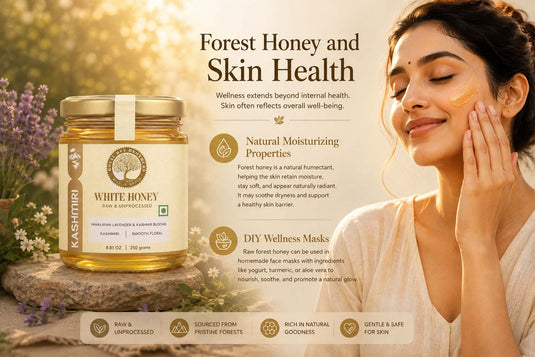
In cosmetic terminology, ingredients that attract water are commonly described as humectants. Honey is recognized as a naturally derived humectant ingredient, although the performance of any finished cosmetic depends on the complete formulation rather than honey alone.
A modern study examining honey-based cosmetic formulations found that moisturizing effects could vary according to honey concentration and the composition of the overall formulation. This is an important reminder that cosmetic performance is a property of the finished product, not simply a single ingredient in isolation.
The Difference Between Natural Honey and a Honey Cosmetic
This distinction is essential for anyone interested in natural beauty.
A jar of culinary honey and a professionally formulated honey-based cosmetic are not necessarily interchangeable.
A cosmetic formulation may combine honey with water, botanical extracts, oils, emulsifiers, preservatives, humectants and other ingredients. The purpose is to create a product with controlled texture, stability, sensory performance and shelf life.
This is why a modern honey face cream may feel completely different from raw honey even though both contain honey.
Cosmetic scientists can also use honey-derived ingredients rather than honey itself. For example, reviews of bee-derived cosmetic ingredients describe hydrogenated honey, honey extracts and modified honey derivatives used for specific formulation purposes.
The result is a fascinating bridge between traditional natural beauty and modern formulation technology.
Honey, Skin Softness and the Beauty of a Well-Hydrated Surface
When people describe beautiful skin, they often use words such as soft, smooth, supple, fresh and radiant.
These qualities are closely connected with the condition of the outermost layer of the skin, known as the stratum corneum.
The stratum corneum contains cells surrounded by a complex mixture of lipids and natural moisturizing components. Water content within this outer layer influences how the skin feels and appears.
When the surface is well hydrated, fine surface irregularities can appear less pronounced and the skin can feel more comfortable and flexible. This is one reason hydration is central to modern cosmetic skin care.
Honey's humectant properties make it an intriguing natural ingredient within this broader approach to maintaining a moisturized skin surface.
It is not magic. It is chemistry.
The Hidden Complexity Inside a Spoonful of Honey
Honey may look like a simple golden syrup, but chemically it is remarkably complex.
Sugars and water make up most of its composition, while smaller quantities of proteins, enzymes, organic acids, minerals, vitamins and plant-derived compounds contribute to its distinctive characteristics.
Among the compounds receiving scientific attention are phenolic acids and flavonoids.
These plant-associated compounds are one reason honey is studied for antioxidant activity. Their concentration and profile can vary according to botanical source, geographical origin, processing and other factors.
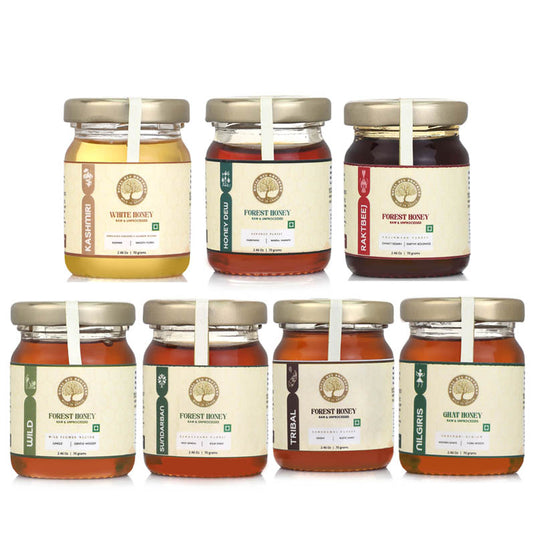
This variation is particularly relevant to Royal Bee Brothers because India's extraordinary floral diversity creates an equally fascinating diversity of honey.
A forest honey collected in one ecological region does not necessarily have the same chemical profile as a floral honey produced somewhere else.
Honey for Hair & Complete Beauty Care
In the next chapter, we move beyond facial skin and explore honey's place in hair care, scalp-friendly beauty routines, conditioning, shine, softness, lip care, body care and traditional honey beauty rituals.
We will also explore why honey-derived ingredients can behave differently from raw honey in shampoos, conditioners and modern personal-care products.
Honey's beauty story does not end with facial skin. For generations, natural beauty traditions have explored honey alongside oils, flowers, herbs and other botanical ingredients for hair grooming, body care and everyday personal beauty.
Modern cosmetic science has expanded this story further. Honey and honey-derived ingredients can now be found in shampoos, conditioners, masks, lip products, creams, lotions and other personal-care formulations.
The reasons vary from one product to another. Sometimes the attraction is honey's humectant character. Sometimes it is its conditioning potential. Sometimes it is the sensory experience, natural-origin story or formulation possibilities.
This makes honey particularly interesting as a beauty ingredient because it can move across different categories without losing its natural identity.
Why Hair Needs Moisture and Conditioning
Hair may look simple, but each strand is a highly structured material made primarily from keratin.
The outer surface of the hair fibre is covered by overlapping cuticle cells. The condition of these cells influences how hair reflects light, how easily strands slide against one another and how smooth or rough the hair feels.
When hair becomes dry, the surface can feel rougher and more difficult to manage. Cosmetic hair care therefore focuses heavily on conditioning, lubrication, moisture management, combability and shine.
This is where honey-derived ingredients become relevant.
Modern hair-care formulations can use humectants, conditioning agents, oils, silicones, proteins and polymers in carefully balanced combinations. Honey or modified honey ingredients can be incorporated into that system to contribute specific formulation properties.
Honey and the Traditional Hair-Care Ritual
Long before modern shampoos and conditioners existed, people cared for hair using materials available in their surroundings.
Oils, plant infusions, clays, aromatic flowers, herbal powders and naturally sweet materials all appeared in different cultural approaches to hair grooming.
Historical literature describing honey's cosmetic uses records traditional preparations in which honey was combined with water or oils for personal grooming and hair-related beauty practices.
These traditions should be appreciated as cultural knowledge rather than interpreted as modern laboratory evidence.
The interesting connection is that some of the sensory characteristics valued historically—softness, manageability, fragrance and shine—remain important goals in contemporary hair cosmetics.
Honey as a Hair Humectant
The same chemistry that makes honey interesting for skin also makes it relevant to hair.
Honey contains sugars with strong interactions with water. This gives it humectant characteristics.
In hair cosmetics, humectants are commonly used to help manage the moisture environment of the hair fibre and improve the sensory experience of conditioning products.
Why this matters for hair beauty
Hair that feels soft and flexible is generally easier to comb and style than hair that feels excessively dry and rough. Cosmetic ingredients that influence water interaction, lubrication and surface properties can therefore contribute to the overall feel and appearance of hair.
Honey's natural water affinity gives formulators one possible tool within this larger conditioning system.
But again, honey is not a complete conditioner by itself.
Modern hair products work through combinations of ingredients. Honey may be one part of a formula containing cationic conditioning agents, oils, polymers, proteins and other materials selected for specific performance.
Honey-Derived Ingredients in Modern Hair Care
One of the clearest examples of the transition from traditional honey to modern cosmetics is the development of honey-derived conditioning ingredients.
Cosmetic ingredient reviews describe materials such as hydroxypropyltrimonium honey as hair-conditioning ingredients used in shampoos and conditioners.
The advantage of a modified derivative is that the chemist can alter the behaviour of the original natural material so it becomes more compatible with a particular cosmetic system.
In other words, the goal is not necessarily to put a spoonful of raw honey into a shampoo.
Instead, modern formulation science can take inspiration from honey's chemistry and create a cosmetic ingredient that behaves predictably inside a finished product.
Raw honey has a distinctive natural composition. Cosmetic scientists can use honey directly, use extracts, or work with modified honey-derived ingredients depending on the desired performance of the final product.
The Beauty of Shine
Hair shine is largely a story about light.
A smoother hair surface can reflect light more regularly, creating a more polished and glossy appearance. Surface roughness, cuticle condition, oils and conditioning agents can all influence how hair looks.
This is why conditioners can make hair appear shinier even when the hair fibre itself has not fundamentally changed.
A well-formulated product can reduce friction and improve the alignment and feel of the hair surface, producing a smoother visual finish.
Honey can contribute to the overall conditioning concept, especially when incorporated with other ingredients designed to improve hair feel and surface properties.
The result is not necessarily "honey creates shine."
A more accurate beauty-science description is that honey or honey-derived ingredients may contribute to a conditioning formulation designed to improve softness, manageability and the visual finish of hair.
Honey for Dry-Looking Hair
"Dry hair" is primarily a cosmetic description of how hair looks and feels.
It may appear dull, feel rough or become difficult to manage. Environmental exposure, heat styling, frequent washing, chemical processing and mechanical friction can all influence the surface characteristics of hair.
Beauty routines designed for dry-looking hair often focus on conditioning and reducing the rough feel of the fibre.
Honey can fit naturally into this category because of its moisture-related properties.
However, the formulation determines the final experience. A honey-containing conditioner with carefully selected emollients and conditioning agents can feel completely different from raw honey applied directly to hair.
Honey Hair Masks: The Traditional Idea Reimagined
The hair mask is one of the simplest ways to understand the appeal of honey in beauty culture.
A mask is generally designed to remain on the hair longer than an ordinary rinse-off cleanser. This provides more time for the formulation to interact with the hair surface.
Traditional beauty recipes often combined honey with oils or other natural ingredients.
Modern cosmetic versions can take the same basic concept and make it more elegant by combining honey-derived ingredients with conditioners, botanical extracts and lightweight emollients.
Honey and Curly Hair Beauty
Curly and textured hair can have particularly complex moisture and conditioning needs.
The bends and twists along a curly fibre can influence how natural oils move along the hair shaft. As a result, conditioning routines often place a strong emphasis on softness, slip, flexibility and moisture management.
Humectants are frequently included in products designed for textured hair, although their behaviour can depend on environmental humidity and the complete formulation.
Honey's humectant nature therefore makes it an interesting ingredient for curly-hair formulations, particularly when balanced with conditioning and film-forming ingredients.
The key word is balance.
A sophisticated formulation is not simply "more humectant = better hair." Formulators consider the entire system, including humidity, hair type, product concentration, rinse-off time and the behaviour of other ingredients.
Honey and the Luxury of Hair Texture
Luxury beauty is often experienced through touch.
The feeling of running fingers through smooth hair can be just as important as the visual appearance.
Cosmetic scientists call this kind of experience sensory performance.
Does the shampoo spread easily? Does the conditioner provide slip? Does the hair feel silky after rinsing? Does the product leave a heavy or lightweight finish?
Honey's natural story fits beautifully into this sensory world because the ingredient itself has a distinctive viscosity and texture.
In a finished formulation, however, those characteristics can be carefully controlled.
Honey for Lip Beauty
Lips are another natural place for honey's beauty story.
Lip products are designed around comfort, smooth application, shine, softness and a pleasant sensory experience.
Honey's sweetness, viscosity and moisture-related characteristics make it a natural inspiration for lip-care formulations.
Modern lip products may combine honey or honey-derived ingredients with plant oils, waxes, butters and other conditioning materials.
The resulting product can be designed as a balm, gloss, mask or treatment-free conditioning product focused purely on appearance and comfort.
The appeal is also emotional. Honey suggests warmth, sweetness and natural luxury—qualities that translate especially well into lip-care packaging and sensory design.
The Honey Lip Mask Concept
Overnight lip masks have become popular within modern beauty routines because they create a simple ritual: apply a rich conditioning product before sleep and wake up to a softer-feeling surface.
Honey fits naturally into this concept because of its humectant character.
However, a professionally formulated lip mask is much more than honey. Waxes, oils, butters and film-forming materials can create the desired texture and help the product remain comfortably on the lips.
This is another example of the central principle of this series:
Cosmetic performance comes from the interaction between the ingredient, concentration, formulation base, packaging and method of use.
Honey and Body Care
The body-care category offers perhaps the widest canvas for honey-inspired beauty.
Body lotions, creams, shower products, scrubs and bath products can incorporate honey or honey-derived ingredients as part of a moisturizing and sensory formulation.
Body moisturizers often combine humectants with emollients and occlusives. Honey can contribute to the humectant side of that system.
A honey body lotion may therefore combine honey with botanical oils, shea butter, plant extracts and other ingredients designed to create a soft, smooth finish.
In premium formulations, the honey story can also be combined with fragrances inspired by flowers, forests, vanilla, citrus, herbs or warm woods.
Honey in Bath and Shower Rituals
Beauty rituals are not only about measurable cosmetic effects.
They are also about atmosphere.
Warm water, fragrance, texture and the feeling of slowing down can transform a simple routine into a sensory experience.
Honey works exceptionally well within this concept because its natural associations are so rich: bees, flowers, golden colour, sweetness, warmth and abundance.
Honey-inspired shower gels, bath products and body washes can use these associations without making exaggerated promises about what the ingredient does biologically.
This distinction is increasingly important in premium beauty.
Consumers are often attracted to natural ingredients because of the story and sensory experience as much as the ingredient's technical function.
Honey and Exfoliation: A Sensory Perspective
Exfoliating products are designed to improve the feel and appearance of the skin surface by removing or loosening surface buildup.
Honey itself is not a conventional physical exfoliant. It does not contain abrasive particles in the way sugar, salt, crushed seeds or mineral powders do.
However, honey can be incorporated into exfoliating formulations as a conditioning and humectant component.
Imagine a body scrub containing sugar crystals, plant oils and honey. The sugar provides the physical texture, the oils contribute emollience, while honey can contribute moisture-related and sensory characteristics.
This is an excellent illustration of formulation synergy.
Honey and Natural Beauty Minimalism
The modern beauty consumer increasingly encounters two seemingly opposite trends.
One is highly engineered skin care, filled with specialized active ingredients and laboratory-designed molecules.
The other is natural beauty minimalism: fewer ingredients, recognizable materials and a stronger connection with nature.
Honey sits comfortably between these worlds.
It is a recognizable natural ingredient with a long cultural history, yet it is also chemically complex enough to interest modern cosmetic scientists.
A premium honey cosmetic can therefore tell both stories.
The Beauty of Honey + Oil
Honey and oil represent two different sides of a moisturizing formulation.
Honey is water-loving and humectant in character. Oils are generally lipophilic and can contribute emollient and occlusive properties.
Combining them can therefore create an interesting formulation system, provided the ingredients are properly incorporated.
Traditional beauty recipes frequently brought honey and oils together. Modern cosmetic science can make that combination much more stable and elegant through emulsification technology.
Why emulsions matter
Oil and water naturally separate. A cosmetic cream brings them together using emulsifiers and carefully controlled processing. This allows formulators to combine water-loving and oil-loving ingredients into a stable, spreadable product.
Honey can therefore become part of a sophisticated cream rather than remaining a sticky standalone ingredient.
Raw Honey vs. Honey-Based Cosmetics
It is tempting to assume that using raw honey directly is automatically better because it is more "natural."
Cosmetic science tells a more nuanced story.
Raw honey has a variable natural composition and a sticky texture. A formulated product can standardize concentration, combine complementary ingredients, control viscosity and create a more predictable sensory experience.
For daily beauty routines, this can be a significant advantage.
A professionally formulated honey shampoo, conditioner, cream or lip product is designed for its specific application.
Natural origin and modern formulation are not opposites.
The two can work together.
The Royal Bee Brothers Approach to Honey Beauty
For Royal Bee Brothers, the opportunity is bigger than simply putting honey on a label.
The brand can tell a complete story connecting the hive to modern beauty:
Flower → Bee → Honey → Chemistry → Formulation → Beauty Ritual.
Every step adds meaning.
The flower determines part of the honey's identity. Bees transform nectar through their remarkable natural processes. The resulting honey develops its own colour, aroma and chemical profile. Cosmetic scientists can then incorporate honey or honey-derived materials into carefully designed products.
The final experience is therefore a collaboration between nature and formulation science.
From Forest Flowers to Golden Honey
Curious about where authentic forest honey comes from? Explore our complete guide to India's wild forest honey—its origins, harvesting traditions, regional character, purity, crystallization and everyday uses.
Explore the story behind one of nature's most fascinating golden ingredients.
The Three Beauty Characteristics to Remember
Humectant Character
Honey contains sugars that interact strongly with water. This makes honey and honey-derived materials interesting in moisture-focused cosmetic formulations.
Sensory Character
Honey contributes a distinctive texture, aroma, colour and natural-origin story that can enrich the experience of a cosmetic product.
Formulation Flexibility
Honey can be incorporated into creams, masks, shampoos, conditioners, lip products and body-care formulations, while honey-derived ingredients can be modified for specific cosmetic functions.
Frequently Asked Questions About Honey for Skin
Is honey good for skin?
Yes, raw honey is exceptionally beneficial for all skin types. It is packed with natural enzymes, antioxidants, trace vitamins, and minerals that protect, nourish, and repair the skin barrier. Science confirms its natural antibacterial and anti-inflammatory properties, making it an effective remedy for acne, dullness, and dehydration.
[Scientific Reference: Honey in Dermatology & Wound Healing]What are the benefits of honey for skin?
Honey offers a wide range of dermatological benefits:
• Deep Hydration: Pulls moisture into the skin as a natural humectant.
• Acne Reduction: Inhibits acne-causing bacteria like Propionibacterium acnes.
• Gentle Exfoliation: Natural gluconic acid gently sheds dead skin cells.
• Anti-Aging & Repair: Rich in flavonoids and phenolic acids that fight free radicals.
• Soothes Inflammation: Calms redness, eczema, and skin irritation.
Does honey moisturize dry skin?
Yes, honey is a natural power-moisturizer for dry and flaky skin. Unlike heavy oils that sit on top of the skin, honey absorbs moisture from the environment and binds it directly to the epidermis. This strengthens the lipid barrier, restores elasticity, and prevents Transepidermal Water Loss (TEWL).
[Scientific Reference: Honey as a Therapeutic Agent for Barrier Function]Can honey help make skin look glowing?
Absolutely. Honey produces a natural, radiant skin glow. It contains low levels of organic acids (like AHA gluconic acid) that dissolve dull, dead surface cells. Its combination of micro-nourishment, circulation improvement, and surface hydration provides an immediate luminous complexion without greasy residue.
[Scientific Reference: Antioxidant Activities & Bioactive Compounds in Honey]Is raw honey good for the face?
Raw, unpasteurized honey is the gold standard for facial application. Commercially processed honey is heated and ultra-filtered, destroying the delicate enzymes (like glucose oxidase), beneficial pollen, and propolis. Raw honey retains these living compounds, maintaining a skin-friendly pH (around 3.2 to 4.5) that supports a healthy skin microbiome.
[Scientific Reference: Biological Properties of Unpasteurized Honey]How does honey hydrate the skin?
Honey hydrates through high sugar concentration (fructose and glucose) coupled with trace amino acids. These components behave as natural moisturizing factors (NMFs). When applied to damp skin, honey forms an osmotic layer that locks in water molecules, plumping up stratum corneum skin cells.
[Scientific Reference: Osmotic Activity & Humectant Properties of Honey]Can honey be used as a face mask?
Yes, raw honey makes a highly effective DIY face mask. Simply spread a thin layer of pure raw honey onto damp, clean skin and leave it on for 15 to 20 minutes before rinsing with warm water. It can also be blended with ingredients like plain yogurt (lactic acid) or ground oats to target specific concerns like hyperpigmentation or irritation.
[Scientific Reference: Topical Application of Natural Honey Masks]Is honey a humectant?
Yes, honey is one of nature’s most effective natural humectants. Humectants are substances that attract and retain moisture from the surrounding atmosphere into the skin. Its chemical structure—comprising sugars, organic acids, and enzymes—allows it to hold several times its weight in water.
[Scientific Reference: Physicochemical Properties & Water Activity of Honey]What is the difference between raw honey and honey-based skincare products?
• Pure Raw Honey: 100% concentrated, bioactive honey straight from the hive. It offers maximum enzymes and potency, though it can feel sticky.
• Honey-Based Skincare: Formulated products combining honey extracts with stabilizing ingredients, oils, or botanical emulsifiers for cosmetically elegant textures (creams, serums, cleansers) with longer shelf lives.
Can different types of honey have different skincare properties?
Yes, the floral source significantly affects honey’s cosmetic profile:
• Manuka Honey: Exceptional antibacterial strength due to high Methylglyoxal (MGO) levels—ideal for severe acne.
• Acacia Honey: Mild, highly hydrating, and rich in flavonoids—perfect for delicate, dry skin.
• Buckwheat Honey: High concentration of antioxidants—excellent for anti-aging and free radical defense.
• Wildflower Honey: Broad-spectrum floral nutrients that balance oily and combination skin.
Scientific & Historical References
- Burlando B, Cornara L. Honey in dermatology and skin care: a review. This review examines honey's composition, traditional uses and relevance to cosmetic and personal-care applications.
- Cherian P, Bergfeld WF, Belsito DV, et al. Safety Assessment of Honey-Derived Ingredients as Used in Cosmetics. International Journal of Toxicology. 2025;44(2 Suppl):5S–18S.
- Draelos ZD. The science behind skin care: Moisturizers. Journal of Cosmetic Dermatology. 2018;17(2):138–144.
- Honey: Chemical composition, stability and authenticity. Food Chemistry. Review literature describing the major and minor constituents of honey and factors affecting its composition.
- Medicinal and cosmetic uses of Bee's Honey — A review. Historical and scientific review of honey applications, including traditional cosmetic practices.
- Hydration and Barrier Potential of Cosmetic Matrices with Bee Products. Research investigating honey-containing cosmetic formulations and their cosmetic properties.
- Innovative Honey-Based Product and Its Beneficial Effects Measured by Modern Biophysical and Imaging Skin Techniques. Research examining cosmetic formulations containing honey and instrumental measurements of skin appearance and hydration-related parameters.
- Cosmetic Ingredient Review. Safety Assessment of Honey-Derived Ingredients as Used in Cosmetics. Assessment of honey and honey-derived ingredients used in cosmetic formulations.