Tribal Forest Honey Traditions: Ancient Wisdom Behind India’s Wild Honey Heritage
Table of Contents
- 1. Introduction
- 2. How Do Tribal Honey Hunters Locate Hives?
- 3. The Origins of Tribal Honey Hunting in India
- 4. Why Forest Honey Holds Special Importance in Tribal Culture
- 5. The Giant Indian Rock Bee: The Heart of Tribal Honey Traditions
- 6. Tribal Honey Harvesting Communities of India
- 7. Experience & Verification Matrix
- 8. How Tribal Honey Hunters Locate Wild Bee Colonies
- 9. Traditional Honey Harvesting Methods
- 10. Sustainability Principles Embedded in Tribal Traditions
- 11. Tribal Forest Honey Traditions and Modern Consumers
- 12. The Relationship Between Forest Conservation and Honey Traditions
- 13. Traditional Knowledge Passed Through Generations
- 14. Challenges Facing Tribal Honey Traditions Today
- 15. The Rise of Ethical Forest Honey Sourcing
- 16. Why Tribal-Harvested Forest Honey Is Unique
- 17. Scientific & Institutional References
- 18. Frequently Asked Questions (FAQs)
Introduction
Long before commercial beekeeping, industrial honey processing, and supermarket shelves filled with standardized sweeteners, India's forests were home to a remarkable relationship between humans and bees. Across mountains, mangrove forests, tropical jungles, and remote tribal territories, indigenous communities developed sophisticated methods for gathering premium tribal forest honey while preserving the ecosystems that sustained them.
Before exploring traditions, read our Ultimate Guide to Forest Honey in India to understand harvesting methods, purity standards, benefits, and authenticity indicators.
These traditions are not merely methods of collecting honey. They represent a complete ecological philosophy—one built on respect for nature, sustainable resource management, spiritual beliefs, and generations of accumulated forest knowledge. Today, as consumers increasingly seek authentic foods and sustainable products, exploring unadulterated tribal forest honey offers valuable insight into the origins of some of the world's finest wild honey.
From the towering cliffs of the Western Ghats to the dense forests of Odisha, from the mangrove labyrinths of the Sundarbans to the mountain valleys of Nagaland, tribal communities continue to practice ancient honey-harvesting techniques that have remained largely unchanged for centuries. This guide explores the fascinating world of India's tribal honey traditions, the communities who preserve them, and the cultural wisdom that transforms wild forest honey into one of nature's most extraordinary gifts.
How Do Tribal Honey Hunters Locate Hives?
Tribal honey hunters locate wild bee colonies by tracking the flight directions and altitudes of returning foragers, interpreting seasonal forest blooming cycles, and reading subtle environmental markers unique to the regional wilderness landscape.
Support Ancient Indigenous Craftsmanship
Every bottle purchased directly ensures fair wages and preserves the protective forestry traditions of India's tribal communities.
Discover Heritage Wild HoneyThe Origins of Tribal Honey Hunting in India
Human interaction with wild honey dates back thousands of years. Archaeological evidence from rock paintings across India depicts honey collection activities believed to be several millennia old. For tribal societies, raw tribal forest honey was never viewed simply as food. It served multiple vital purposes across their community structures:
- Natural Sweetener: Providing high-energy nourishment extracted directly from untouched natural biomes.
- Traditional Medicine: Acting as a protective element within ancestral health treatments.
- Ritual Offering: Functioning as a central component within seasonal spiritual practices.
- Trade Commodity: Serving as a highly valued bartering asset between forest borders and plain villages.
- Energy Source: Sustaining hunters during long, physically demanding wilderness expeditions.
- Sacred Gift: Viewed as an honor directly provided by guiding forest spirits.
Generations of tribal elders carefully observed bee behavior, flowering seasons, migration patterns, weather cycles, and forest ecology. This accumulated knowledge eventually evolved into highly specialized honey-harvesting traditions unique to each region. Unlike modern extraction methods focused on maximum yield, tribal honey hunting emphasized long-term coexistence with bee populations. The objective was simple: harvest enough honey for community needs while ensuring the colony survives and continues thriving. This philosophy remains the foundation of traditional honey collection practices today.
Why Forest Honey Holds Special Importance in Tribal Culture
For many indigenous communities, natural tribal forest honey occupies a position far beyond that of a food product, acting as a deep cornerstone of cultural identity. Understanding how forest honey is harvested helps clarify why these pristine fluid extracts are treated with such high communal reverence.
Symbol of Prosperity
Many tribes view abundant honey harvests as signs of ecological health and community prosperity. Healthy bee populations indicate productive forests, adequate rainfall, diverse flowering plants, and balanced wildlife ecosystems. A successful honey season traditionally symbolizes abundance for the entire community.
Sacred Spiritual Significance
Across various tribal cultures, bees are considered messengers between humans and nature. Wild tribal forest honey often plays important roles in harvest festivals, marriage ceremonies, birth celebrations, healing rituals, community gatherings, and religious offerings. In some regions, honey is regarded as a blessing from forest deities and must be collected with gratitude and humility.
Long before the honey harvesting season begins, tribal honey gatherers perform sacred rituals to seek the blessings of forest deities who are believed to protect the forests, bees, and their communities. According to tribal traditions, these ceremonies can continue for four to five days and include prayers, offerings, folk songs, and community gatherings. The rituals are performed to express gratitude, ensure a safe harvest, and maintain harmony between humans and nature. Tribal communities believe that honoring the forest deity brings protection, abundance, and success during the challenging process of collecting wild forest honey from remote wilderness areas.

The Giant Indian Rock Bee: The Heart of Tribal Honey Traditions
The majority of India's wild forest honey comes from one extraordinary species: Apis dorsata. Known as the Giant Indian Rock Bee, Apis dorsata differs significantly from domesticated honeybee species through several extreme evolutionary characteristics:
- Enormous colony sizes reaching tens of thousands of active foragers.
- Massive open-air single combs built without protective hollows.
- Highly aggressive, tightly coordinated colony defense systems.
- Long-distance regional migration patterns dictated by seasonal monsoons.
- Exceptional honey accumulation capacities.
These bees construct enormous single-comb hives on tall forest trees, cliff faces, rocky overhangs, and river valley walls. Because Apis dorsata cannot be domesticated successfully, traditional tribal communities remain among the few groups capable of harvesting their honey safely and sustainably. The organic nectar they collect yields the genuine essence of pure tribal forest honey, making it completely distinct from standard farm-raised varieties.
Overview of India's Traditional Honey Harvesting Communities
The geographical spread of traditional honey harvesting across India's remaining wild biomes showcases a rich diversity of community systems and localized skills. Finding the absolute best forest honey in India means mapping out these precise, historical regional collection zones:
| Tribal Community Location | Core Ancestral Ecological Skills | Primary Nesting Landscapes |
|---|---|---|
| Odisha Forest Clans | Tracking deep canopy foraging behavior, calculating local bloom periods, non-destructive smoke extraction. | Deciduous Sal and Arjun canopies within Similipal. |
| Sundarbans Moulis | Precise silent team communication, tiger and predator evasion, tidal timing calculation. | Dense, muddy mangrove forest thickets. |
| Nagaland Mountain Clans | Management of traditional log-hive systems, community harvesting laws, post-monsoon tracking. | Vertical mountain slopes and montane paths. |
| Western Ghats Tribes | Weaving flexible forest vine ladders, descending sheer cliff drops, mapping tropical evergreen honey flows. | High rock cliff faces and deep river valleys. |
Experience & Verification Matrix
To build verifiable trust and clarify the rigorous tracking behind our wild collections, the Royal Bee Brothers editorial panel highlights the core professional components framing our field work with authentic tribal forest honey lineages:
| Area | Core Competency & Trust Factors | Institutional Alignment |
|---|---|---|
| Field Experience | Deep ecological tracking across deep Indian forests to understand the migration patterns and foraging seasons of Apis dorsata (indigenous giant rock bees). | Mapping and monitoring of high-density bee forage flora as categorized under the Forest Survey of India canopy classification blueprints. |
| Sourcing Experience | Direct tree-to-pack logistics ensuring 100% raw, unpasteurized, and chemically unadulterated forest honey. Elimination of middlemen to maintain strict traceability and quality control. | Implementing clean extraction, moisture control, and chemical-free purity parameters mapped out in the scientific frameworks of the National Bee Board. |
| Tribal Partnerships | Fair-trade collaborations built upon centuries-old traditional indigenous tracking and honey-harvesting knowledge passed down orally through forest generations. | Direct alignment with sustainable collection mechanisms, socio-economic empowerment models, and minor forest produce pricing criteria outlined by TRIFED (Tribal Cooperative Marketing Development Federation of India). |
Trust Note from our Specialist: Harvesting wild tribal forest honey requires a rare blend of deep technical precision and ancient traditional mastery. To protect local biodiversity, extraction must be non-destructive, leaving the queen bee and the brood section of the comb completely intact. This scientific and community-led approach keeps our natural forest ecosystems healthy while providing sustainable, fair-trade seasonal livelihoods to India's forest-dwelling indigenous groups.
Want to taste the single-origin variations of these regions?
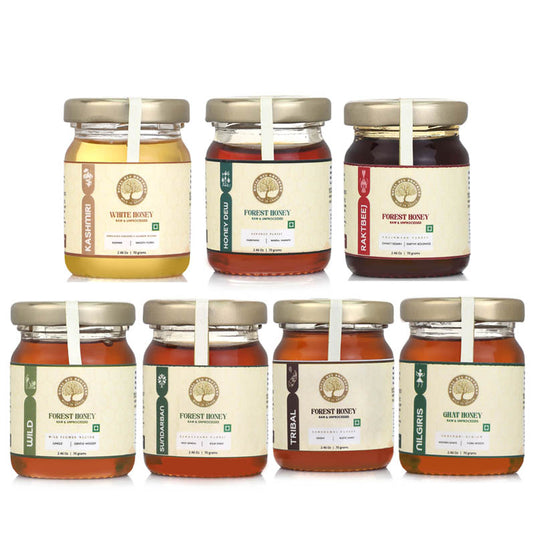
Explore Single-Origin Tribal Honey Assortments →How Tribal Honey Hunters Locate Wild Bee Colonies

Finding wild tribal forest honey deep in dense jungles is a complex art. Experienced honey hunters rely entirely on generations of accumulated field observation:
- Observing Bee Flight Patterns: Honey hunters carefully watch the exact direction of bee movement, flight altitude, foraging behavior, and time-of-day activity at localized water bodies. Returning foragers quickly reveal the precise coordinates of hidden colonies.
- Tracking Flowering Seasons: Different plant species bloom across shifting cycles. Experienced gatherers map nectar-rich flowering periods, regional bloom calendars, and weather influences on nectar flow to determine exactly where swarms will build hives.
- Reading Forest Signs: Tribal honey hunters recognize subtle environmental clues such as specific flight sounds, nested tree species preferences, cliff microclimates, and ancestral seasonal migration paths.
Traditional Honey Harvesting Methods
The physical process of extraction combines deep nerve, agility, and absolute respect for the target colony. Reviewing a detailed breakdown of how forest honey is harvested reveals the immense physical risks these indigenous groups face during nightly climbing expeditions:
- The Importance of Timing: Successful honey collection depends heavily on waiting until honey storage cells are fully capped with natural wax, moisture content drops to stable levels, and weather conditions turn clear.
- Natural Smoke Techniques: One of the most iconic aspects of tribal honey harvesting involves controlled use of smoke. Gatherers prepare smoldering bundles from dry leaves, forest grasses, and specific medicinal plant materials. This cool smoke temporarily calms the colony, causing them to move away from honey sections without harming individual bees.
- Selective Comb Harvesting: The most critical element of tribal wisdom is selective cutting. Gatherers only remove the mature honey-storing sections of the comb, leaving the lower brood cells, developing larvae, and the queen's domain fully intact to ensure rapid recovery and future yields of authentic tribal forest honey.
Sustainability Principles Embedded in Tribal Traditions
Modern sustainability experts view traditional honey harvesting as a model of regenerative resource management. These ancient guidelines for preserving tribal forest honey biomes include:
- Never Harvest Everything: Taking all available honey directly threatens colony survival; substantial portions are always left behind to feed the bees through lean periods.
- Protect Bee Populations: Healthy, undisturbed wild bee populations ensure future seasonal yields, making colony preservation both economically and ecologically essential.
- Respect Seasonal Cycles: Harvesting strictly follows natural ecosystem rhythms rather than commercial market demands, preventing overexploitation.
- Maintain Forest Biodiversity: Bees depend entirely on diverse flowering plants, prompting tribal communities to actively defend their surrounding forest blocks from degradation.

Tribal Forest Honey Traditions and Modern Consumers
In an era dominated by mass production and ultra-processed foods, modern health-conscious consumers are undergoing a major shift toward wellness transparency. Today's buyers do not just look at a product's nutritional label; they seek to understand the entire story, geography, and ethics behind what they consume. This shifting marketplace dynamic has generated a massive resurgence of interest in authentic tribal forest honey. Urban consumers are quickly discovering that mass-manufactured syrups cannot match the complex flavor notes or intense enzyme profiles found in single-origin wild harvests.
When evaluating options, analyzing a detailed breakdown of forest honey vs regular honey becomes incredibly eye-opening for the modern shopper. Regular commercial honey is frequently derived from monoculture crop farms where bees are exposed to synthetic pesticides and fed sugar water. It is then heavily heated, pasteurized, and ultra-filtered, which destroys its volatile nutritional values to prolong store shelf-life. Conversely, raw tribal forest honey remains completely unheated and retains its natural micro-particles of propolis, royal jelly, and wild flower pollen grains intact.
Furthermore, modern buyers increasingly direct their purchasing power toward supporting ancestral craftsmanship and fair-trade ethics. Choosing real tribal forest honey directly supports fair wages for indigenous forest-dwelling gatherers who risk their lives to preserve these ecological landscapes. By bridging ancient gathering practices with conscious modern commerce, consumers receive unmatched nutritional purity while actively participating in a global movement to keep ancient indigenous traditions thriving.
The Relationship Between Forest Conservation and Honey Traditions
Wild tribal forest honey traditions and forest conservation are completely inseparable. Without healthy, intact forests, wild bees disappear, native nectar sources decline, honey yields collapse, and traditional community livelihoods vanish. Consequently, many tribal communities function as informal, frontline guardians of biodiversity. Because their economic and cultural survival depends directly on overall ecosystem health, it creates powerful incentives for sustainable forest management and preventing illegal encroachment.
Traditional Knowledge Passed Through Generations
Honey-harvesting expertise cannot be learned from books or digital guides. Knowledge regarding the extraction of premium tribal forest honey is transferred through intimate community systems:
- Observation: Young community members accompany experienced gatherers on forest borders from an early age.
- Apprenticeship: Practical field experience under stressful wilderness situations forms the core training.
- Oral Traditions: Complex ecological histories, forest maps, and species behavior traits are preserved through ancestral stories, songs, and cultural narratives.
- Community Participation: Seasonal honey collection operates as a collective, multi-generational activity that reinforces social ties.
Challenges Facing Tribal Honey Traditions Today
Despite their resilience, these ancient traditions face unprecedented modern pressures. When evaluating the marketplace to locate the best forest honey in India, consumers must realize the immense ecological and economic hurdles currently impacting these indigenous groups:
Habitat Loss: Accelerating deforestation directly reduces available wild nesting sites and rich floral diversity. Concurrently, Climate Change alters historical rainfall patterns, disrupting seasonal flowering periods, nectar availability, and long-standing bee migration behaviors required to produce authentic tribal forest honey batches.
Furthermore, heavy Industrial Competition from cheap, adulterated mass-market honeys often undercuts prices for authentic wild varieties. A deeper look into forest honey vs regular honey highlights how factory-processed options dilute value, causing significant economic strain and accelerating Knowledge Erosion as younger community members migrate toward urban centers for employment, breaking the chain of traditional skill transmission.
The Rise of Ethical Forest Honey Sourcing
The growing global consumer demand for authentic, unadulterated foods has opened new opportunities for tribal collectives. Responsible ethical sourcing initiatives for pure tribal forest honey emphasize fair trade compensation structures, sustainable non-destructive harvesting workshops, forest land conservation funding, direct community empowerment, and complete digital product traceability. When implemented responsibly, these modern frameworks strengthen local rural economies while providing powerful tools to defend sensitive wilderness landscapes.
Taste the Legacy of Centuries-Old Conservation Philosophy
Our harvest lines are completely raw, unheated, and pulled straight from certified tribal tracks.
Purchase Genuine Raw Wild HoneyWhy Tribal-Harvested Forest Honey Is Unique
Authentic tribal-sourced forest honey stands completely apart from industrial honey through several fundamental properties. Research mapping out verified forest honey benefits highlights how its raw state preserves vital health elements that processed alternates completely lack:
- Diverse Floral Sources: Wild bees forage across hundreds of rare plant and medicinal herb species, producing complex, layered flavor profiles impossible to match in monoculture farmlands.
- Minimal Raw Processing: This raw tribal forest honey undergoes only gentle cloth straining, with no high-heat pasteurization, micro-filtration, or artificial stabilizers, fully preserving its natural properties.
- Distinct Regional Character: Every micro-ecosystem infuses the honey with a unique color, viscosity, and mineral depth that reflects its specific geographic home.
- Living Cultural Heritage: Each jar of genuine tribal forest honey directly represents generations of environmental wisdom, traditional craftsmanship, and ecological respect.
Conclusion
Tribal forest honey traditions represent one of humanity's oldest and most sophisticated relationships with the natural world. Across India's forests, mountains, and mangrove landscapes, indigenous communities continue to practice sustainable harvesting methods refined through centuries of observation and experience.
These traditions demonstrate that food production does not have to come at the expense of ecological integrity. Instead, they offer a powerful example of how humans can work in partnership with nature, taking only what is needed while ensuring future abundance. Every jar of authentic tribal forest honey tells a story far greater than sweetness alone. It reflects ancient wisdom, cultural heritage, forest biodiversity, and the extraordinary dedication of communities who continue to protect one of India's most valuable natural treasures.
As interest in natural foods and sustainable living grows, tribal honey traditions deserve recognition not only for the exceptional honey they produce but also for the ecological lessons they continue to teach the modern world. By choosing ethically sourced tribal forest honey, buyers help support indigenous communities and encourage conservation-focused production systems.
Scientific & Institutional References
- National Bee Board (NBB): Standards on apicultural practices, honey grading, and quality control paradigms for unadulterated, raw mono-floral and multi-floral forest honey production in India (Manoj, 2023).
- Indian Council of Agricultural Research (ICAR): Field documentation on indigenous honeybee foraging behavior, nutritional profiles of wild Apis dorsata variants, and sustainable tribal livelihood development models across regional forest belts (Prasad, 2024).
- Tribal Cooperative Marketing Development Federation of India (TRIFED): Structural guidelines for the ethical collection, primary processing, and value-addition of Non-Timber Forest Products (NTFPs) to preserve indigenous tribal rights and prevent regional over-harvesting (Chakrabarti, n.d.).
- Forest Survey of India (FSI): Data profiles and assessments on forest-edge vegetation, canopy densities, and natural wilderness biomes supporting diverse wild bee populations (Ozukum, 2025).
Literature Citations:
• Chakrabarti, P. (n.d.). Beyond timber: a review on the role of non-timber forest products for ecological sustainability and rural empowerment in India. ResearchGate.
• Manoj, M. S. (2023). Current scenario of beekeeping and honey production in India. Hexapoda (Insecta Indica), 30(1&2), 44-50.
• Ozukum, L., Das, S., Sharma, A., Nakhro, R., Patra, N. K., Dutta, M., & Jangyukala, M. (2025). Identification of non-timber forest products and economic value- A study in Eastern Himalayan States of India. Indian Journal of Ecology, 52(2), 283-292.
• Prasad, J. V. (2024). Sustainable livelihood security through apiculture in the tribal tracts of West Godavari district of Andhra Pradesh. Indian Farming, 74(3), 68-70.
Frequently Asked Questions (FAQs)
1. How do tribal honey hunters locate wild bee colonies?
Tribal honey hunters rely on tracking flight paths and flight altitudes of returning foragers, interpreting seasonal forest blooming cycles, and reading subtle environmental markers unique to the regional wilderness landscape.
2. What is selective comb harvesting in tribal traditions?
It is an ancestral sustainability practice where gatherers only cut away the mature honey-storing sections of the comb while leaving the lower brood nests, queen chambers, and structural foundations fully intact.
3. Why is wild rock bee honey unique compared to apiary honey?
Because it is gathered from unmanaged Apis dorsata bees that forage across thousands of biodiverse forest medicinal plants, resulting in high pollen complexity, dense mineral profiles, and raw, unaltered enzymes.
4. How does ethical sourcing protect forest ecosystems?
By ensuring tribal gatherers receive fair prices for their harvests, it creates strong financial incentives for communities to protect standing wild forests from illegal logging and industrial degradation.
Bring Home the Pure, Unprocessed Legacy of India's Forests
Experience unpasteurized wild honey extracted with generational pride and absolute environmental respect.
Browse Our Full Heritage Honey CollectionWant to learn more about wild honey sourced directly from India's forests?
Explore our Ultimate Guide to Forest Honey in India: Benefits, Purity, Harvesting & Uses to understand how forest honey is collected, how it differs from regular honey, and the key signs of authentic, unprocessed forest honey.
Read the Ultimate Guide to Forest Honey in India →