Best Forest Honey in India: A Complete Guide to Choosing Authentic Wild Honey
Table of Contents
- 1. Introduction
- 2. How Is Forest Honey Harvested?
- 3. Wild Bee Species of the Indian Wilderness
- 4. What Makes Forest Honey Different?
- 5. Characteristics of the Best Forest Honey
- 6. India's Renowned Forest Honey Regions & Seasons
- 7. Traditional Honey Hunting Communities of India
- 8. Risks Faced by Forest Honey Hunters
- 9. Honey Hunting Traditions & Cultural Legacy
- 10. Deep Dive into Botanical Terroirs and Floral Chemistry
- 11. Complex Honey Components & Health Benefits
- 12. Understanding Enzymatic Activity and Crystallization Myths
- 13. Modern Conservation and Ethical Harvesting Standards
- 14. How to Identify Pure Forest Honey
- 15. Frequently Asked Questions (FAQs)
Introduction
India is home to some of the world's most diverse forest ecosystems, stretching from the Himalayan foothills and Northeastern mountain forests to the mangrove wetlands of the Sundarbans and the dense deciduous forests of Central India. These forests provide ideal habitats for wild honeybees that forage on hundreds of flowering trees, medicinal herbs, shrubs, and native plants throughout the year.
The result is one of nature's most extraordinary foods: forest honey. Unlike commercial honey produced from managed apiaries and monoculture agricultural landscapes, true forest honey is collected from wild bee colonies thriving in untouched ecosystems. Rich in natural enzymes, antioxidants, pollen diversity, and regional floral character, forest honey has become increasingly sought after by health-conscious consumers looking for authenticity and purity.
However, with growing demand comes growing confusion. Many products labeled as "forest honey" are heavily processed, blended, or lack clear sourcing information. For consumers seeking genuine wild honey, understanding what makes the best forest honey in India is essential. This guide explores the characteristics of premium forest honey, India's most renowned honey-producing regions, quality indicators, sourcing practices, and how to choose authentic forest honey with confidence.
How Is Forest Honey Harvested?
Forest honey is harvested by skilled honey hunters who locate wild bee colonies in forests, calm bees using natural smoke, carefully remove mature honeycomb sections, and leave brood chambers intact so colonies can recover naturally.
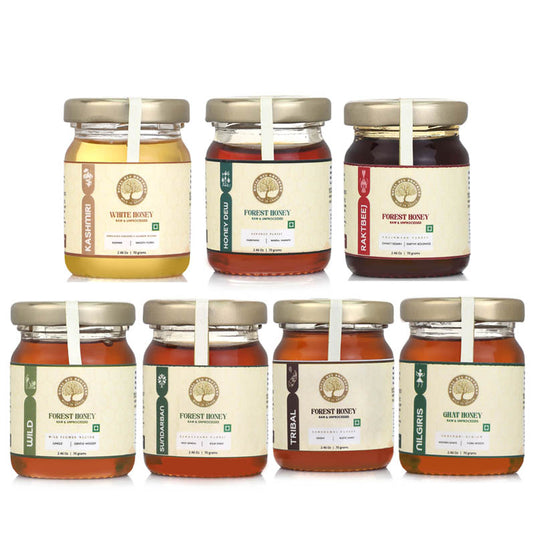
Experience Certified 100% Raw Wild Forest Honey
Ditch mass-market alternatives. Savour the unfiltered polyfloral profile of genuine tribal forest honey sourced sustainably from native reserves.
Explore Pure Wild Honey
Wild Bee Species of the Indian Wilderness
To understand the depth of premium forest honey, one must look at the wild pollinators responsible for its creation. Unlike standard commercial apiaries that utilize domesticated species like Apis mellifera, authentic forest honey collection relies on native, unmanaged wild bee species that are perfectly adapted to the rugged Indian wilderness.
- Apis dorsata (Giant Rock Bee): Known as the backbone of traditional Apis dorsata honey, these ferocious, highly migratory bees build massive, single open-air combs on high rock cliffs and towering forest canopies. They are aggressive foragers, traveling deep into dense jungles to collect exceptional polyfloral nectar. Their nests are primary targets for seasonal honey hunting excursions.
- Apis cerana (Asiatic Honey Bee): Smaller than the giant rock bee, Apis cerana builds multiple parallel combs within enclosed spaces like natural hollow logs, tree cavities, and caves. They are highly resilient and excel at foraging in shaded forest understories.
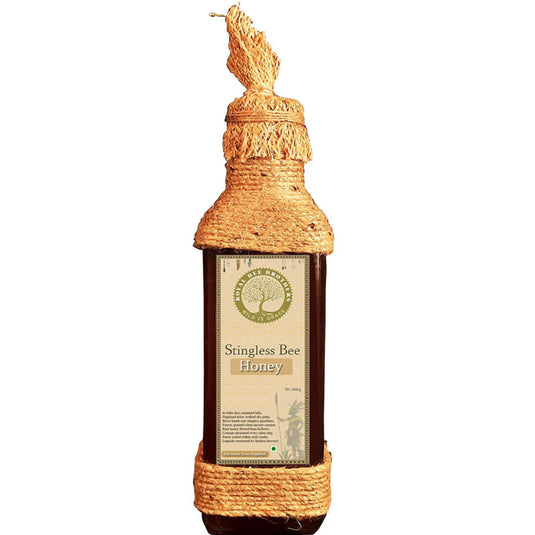
- Stingless Bees (Meliponini): These ultra-small, highly specialized bees build intricate wax pockets rather than typical hexagonal cells. Stingless bee honey is extremely rare, highly acidic, and carries intense therapeutic values due to the dense concentration of medicinal tree resins they gather.
What Makes Forest Honey Different?
Forest honey is fundamentally different from conventional honey because of its untamed origin. Wild bees living in forests are free to forage across vast, pristine spaces filled with diverse nectar sources. Instead of collecting nectar primarily from a single cultivated crop, they gather it from native flowering trees, medicinal herbs, forest shrubs, wild creepers, and seasonal wildflowers.

According to guidelines outlined by the National Bee Board (NBB) and the Indian Council of Agricultural Research (ICAR), raw forest honey extraction must preserve the inherent bio-composition of the honey. This diverse botanical diet contributes to a significantly more complex composition. As a result, authentic wild honey India profiles offer higher pollen diversity, greater antioxidant depth, layered flavor notes, active natural enzymes, and regional mineral variations that cannot be replicated through commercial farming methods.
Characteristics of the Best Forest Honey in India
Not all forest honey is created equal. Premium-quality, authentic products typically share several vital features:
- Wild and Natural Origin: Sourced directly from wild open-combs constructed high in forest canopies, cliffs, or deep natural tree cavities within protected wilderness zones during calculated forest honey collection cycles.
- Minimal Processing: Free from high-temperature pasteurization, micro-filtration, or blending with industrial corn syrups, ensuring the delicate enzymes remain fully intact.
- Rich Floral Diversity: Offers intricate flavor layers, deep shifting aromas, and natural variations that adapt beautifully to every unique seasonal harvest.
- Ethical and Sustainable Sourcing: Built upon close partnerships with indigenous, traditional communities to facilitate fair compensation and support long-term ecological balance.
India's Renowned Forest Honey Regions & Harvesting Seasons
The regional botanical terroir profile of pure forest honey India depends heavily on geographic microclimates and specific regional flowering periods. Organizations like the Tribal Cooperative Marketing Development Federation (TRIFED) work continuously to map these specialized extraction zones:
| Indian Forest Regions | Primary Floral Sourcing Elements | Characteristic Profile | Harvesting Seasons |
|---|---|---|---|
| Similipal Forest (Odisha) | Sal flowers, Arjun trees, Mahua blossoms, and deep wild herbs | Deep amber color, strong robust flavor, high mineral profile | Spring/Early Summer: April to June |
| Eastern Ghats | Wild Tamarind, Neem, Karanja, and native dry-deciduous shrubs | Medium dark color, tangy-sweet undertones, highly viscosity | Pre-Monsoon: May to July |
| Sundarbans Mangroves | Khalisha flowers, Bani, Gewa, and coastal mangrove blossoms | Pale amber hue, distinctive sweet-tart flavor, complex aroma | Peak Spring: March to May |
| Nagaland Forests | Wild mountain orchids, alpine shrubs, and pristine montane vegetation | Light golden color, bright citrus-like notes, delicate floral complexity | Post-Monsoon/Autumn: Sept to November |
Looking for authentic regional honey profiles?
Browse Our Single-Origin Pure Tribal Honey Selections →Traditional Honey Hunting Communities of India
The history of harvesting wild honey in the Indian subcontinent is inextricably linked to the diverse indigenous clans who hold deep generational knowledge of local eco-systems. For these communities, entry into the deep canopy is a spiritual pilgrimage governed by ancestral laws of balance, restraint, and deep environmental respect.
Odisha Tribes
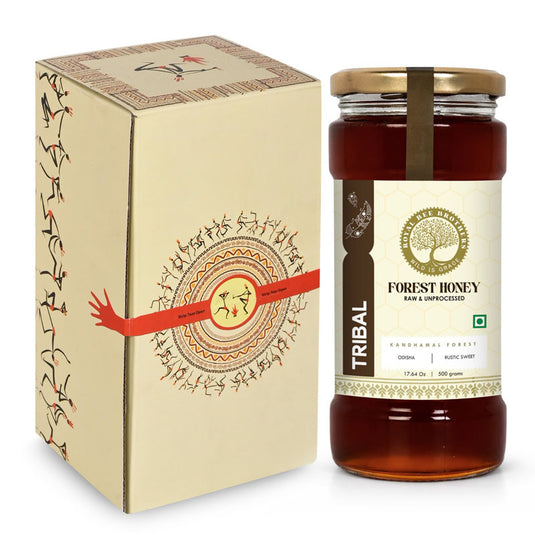
In the vast, dense core of the Similipal Biosphere Reserve, tribal communities such as the Khadia, Mankidia, and Lodha tribes preserve specialized forest skills. They track the flight direction of bees at watering holes to map out nests. Their seasonal wild honey harvesting strategies balance community livelihood needs with strict ancestral taboos that prevent harvesting from immature colonies, ensuring populations bounce back smoothly every year.
Sundarbans Honey Collectors (Moulis)
The traditional Moulis of the Sundarbans form an iconic, highly specialized group of honey collectors. Venturing out into muddy, tidal mangrove mazes during early spring, these gatherers operate under shared spiritual agreements across faiths, praying to forest deities like Bonbibi for protection. Their community structures rely on precise, silent hand gestures to locate high nests of the aggressive giant rock bee without alerting predators.
Nilgiri Honey Gatherers
Deep in the UNESCO-protected Nilgiri Biosphere Reserve, the Kurumba and Irula tribes practice highly technical cliff-side honey hunting. The Kurumbas are renowned for creating long, flexible ladders out of wild forest vines (forest creepers) to descend sheer rock drops. This traditional trade remains highly protected, passed down carefully from fathers to sons through sacred initiation rituals.
Nagaland Forest Honey Hunters
Across the misty, vertical peaks of Nagaland, indigenous clans view forest foraging as a vital community pillar. Nagaland honey gatherers track colonies across steep mountain gaps. Working in tightly knit teams, they coordinate carefully to secure nests built on high branches, ensuring wild yields are shared equally among village elders and families.
Risks Faced by Forest Honey Hunters
The practice of traditional honey harvesting is widely recognized as one of the most physically demanding and dangerous wilderness professions in India. Without modern safety gear or climbing harnesses, traditional honey hunters rely entirely on physical agility, steady nerves, and handmade tools to extract wild combs under extreme environmental pressure.
Falls
The most immediate physical hazard is the extreme height involved. Collectors routinely scale high tree branches or descend sheer rock faces reaching heights of 80 to 150 feet. Working at night on flexible ladders made of wild forest vines, a single snapped knot, loose rock grip, or momentary loss of balance can result in fatal falls or permanent physical injury.
Bee Attacks
The primary target of these harvests is the aggressive giant rock bee (Apis dorsata). If the natural leaf smoke fails to properly calm the swarm, the colony will launch massive, highly coordinated defensive stings. Stranded high on ropes or steep cliffs, hunters must endure hundreds of painful stings without dropping their collection buckets or losing their footing.
Weather
Wild collection seasons run parallel with unpredictable shifting weather patterns. Sudden pre-monsoon thunder storms, strong winds, slippery rain showers, and sudden temperature drops can turn a safe climb into a dangerous trap, making cliff trails unstable and blinding gatherers in the dark.
Wildlife Encounters
Ground environments present severe wildlife dangers. In the Sundarbans mangrove swamps, gatherers face constant, real-world threats from Royal Bengal tigers and estuarine crocodiles. In mainland deciduous belts, collectors must navigate territories shared with wild elephants, bears, and venomous snakes like the King Cobra, making every ground path highly dangerous.
Honey Hunting Traditions & Cultural Legacy
Deeply embedded within India's ecological landscape are ancient honey hunting traditions passed down through generations. Local tribal honey collectors look at wild honey harvesting not merely as a survival livelihood, but as a sacred relationship with nature. Using traditional practices, they track the paths of forest bees, identify hidden hive coordinates, and employ smoke made from specific dried forest leaves to naturally calm wild bee swarms before beginning extraction.
Responsible harvesting practices focus entirely on removing only the mature honey sections of the comb, leaving lower brood chambers completely untouched. This method helps protect wild bee populations while generating sustainable seasonal income for local communities across India's remaining green lungs.
Deep Dive into Botanical Terroirs and Floral Chemistry
The distinction between premium wild honey and farm-grown equivalents lies within structural floral chemistry. When native bees engage in intense seasonal foraging throughout isolated ecosystems, the raw nectar they pull carries distinct botanical properties unique to that single environment. Monoculture farming setups confine bees to uniform fields of mustard, sunflower, or eucalyptus, which limits the resulting honey to a simple chemical structure. In contrast, forest honey collection yields a complex polyfloral profile filled with natural compounds.
In the deep deciduous paths of Central India, the dominant canopy elements include mature Sal (Shorea robusta) and Arjun (Terminalia arjuna) trees. Nectar drawn from Arjun blossoms infuses the honey with specific organic compounds and trace minerals, which are highly valued in traditional Indian wellness systems for supporting cardiovascular vitality. Similarly, the presence of Mahua (Madhuca longifolia) flowers introduces a deep, malty flavor layer and a high fructose-to-glucose ratio, ensuring the honey remains fluid longer before starting its natural crystallization process.
Further south, within mountain valleys, the wild foraging paths contain thousands of endemic shrubs and medicinal herbs. This unique plant diversity results in an exceptional honey density, rich in trace elements like iron, copper, magnesium, and potassium. Each distinct geographical region shapes the physical properties of the honey—influencing everything from its visual thickness to its specific pH level—making authentic Apis dorsata honey a direct, natural reflection of its home environment.

Complex Honey Components & Health Benefits
The nutritional and therapeutic superiority of true forest honey over basic commercial varieties is directly linked to its natural honey components. Commercial processing lines typically filter or heat away these vital elements, but raw forest honey preserves them fully:
- Bee Pollen: Supercharged with natural plant proteins, essential amino acids, and vitamins, bio-diverse bee pollen functions as a potent immune booster and natural anti-inflammatory agent.
- Propolis: This therapeutic, sticky tree resin compound collected by bees to seal hives possesses powerful, natural antimicrobial, antiviral, and antifungal properties.
- Royal Jelly: A nutrient-dense, premium secretion used to feed queen bees, containing rich lipids, proteins, and trace bioactive components that support cognitive vitality.
- Live Active Enzymes: Includes vital enzymes like invertase, amylase, and glucose oxidase, which create trace amounts of natural hydrogen peroxide, delivering strong antibacterial defenses.
According to nutritional publications managed by the Food and Agriculture Organization (FAO), these complex materials combine to establish forest honey as an excellent functional food option. It actively combat oxidative cellular damage, works naturally to soothe coughs and respiratory discomfort, supports smooth digestive health, and provides sustainable energy without the blood sugar spikes caused by highly refined table sugars.
Understanding Enzymatic Activity and Crystallization Myths
One of the most widespread misconceptions among modern consumers is the belief that pure honey must always remain a perfectly clear, uniform liquid. Many assume that a jar showing cloudiness or separating into solid crystals contains added sugar water or artificial corn additives. In reality, the physical shift into a semi-solid state is clear proof of raw, unpasteurized honey.
When honey hunters perform a raw forest honey extraction, the raw material is simply strained through fine mesh cloth to remove large debris while keeping the inner bio-elements completely intact. This means the end product retains hundreds of microscopic native pollen grains, trace bits of propolis, and natural wax particles. These micro-elements act as structural foundations where natural glucose molecules gather, eventually separating from the water content to form smooth, clean crystals. This natural change occurs much faster in environments below 20°C.
Commercial honey packers often subject their inventory to high-temperature pasteurization (heating past 70°C) and micro-filtration under intense pressure. While this high heat melts away any natural crystal formations and extends shelf life indefinitely, it permanently destroys the fragile live enzymes, including invertase and diastase. Unheated, raw forest honey preserves these live enzymes intact. When choosing your honey, look for natural variation—changing textures and seasonal shifts in thickness indicate that the live enzymes inside your jar are fully preserved.
Modern Conservation and Ethical Harvesting Standards
As global market demand for authentic Apis dorsata honey grows, implementing strict conservation practices is essential to protect wild forest bee populations from commercial exploitation and habitat loss. Historically, uncoordinated gathering methods occasionally resulted in the total destruction of wild hives, which disrupted forest ecosystems and reduced local bee counts.
Modern conservation focuses on a balance between community livelihoods and forest health. Government bodies and ethical brands are training local gatherers in advanced, non-destructive extraction methods. By using precise cutting tools, hunters can harvest just the upper honey storage crown while keeping the lower brood nest safe, allowing colonies to rebuild quickly.
Furthermore, these conservation initiatives help protect ancient forest ecosystems. By proving that standing forests generate sustainable income through seasonal forest honey collection, local communities gain a strong financial interest in preventing illegal logging and forest degradation. This framework preserves biodiversity and protects vital wild pollinators for generations to come.
To maintain transparency, leading premium brands implement strict quality and fair-trade metrics:
- Rigorous Laboratory Testing: Every batch must pass advanced testing, checking moisture levels and running nuclear magnetic resonance (NMR) profiling to guarantee 100% freedom from sugar syrup adulteration.
- End-to-End Traceability: Digital tracking setups allow consumers to view the exact tribal collective, forest range coordinates, and processing history behind their specific jar.
- Fair Trade Sourcing Frameworks: Working under fair-trade principles ensures tribal gatherers receive fair compensation, supporting local economies while encouraging forest protection.
Bring the Healing Wealth of Unspoiled Wilderness Into Your Home
Our forest batches are explicitly lab-certified for absolute unpasteurized purity.
Secure Your Lab-Tested JarHow to Identify Pure Forest Honey
With numerous items using misleading labels, smart buyers can protect themselves by evaluating key quality criteria:
- Absolute Sourcing Traceability: Reliable, authentic forest honey brands in India clearly disclose precise geographic origins, regional forest details, and ethical gathering methods.
- Independent Laboratory Verification: Premium brands validate quality by providing batch-testing indicators ensuring complete freedom from added sugar or corn syrups.
- Natural Crystallization Behaviors: Pure raw honey naturally shifts into a thicker, granulated texture over time. This proves the product is unheated, raw, and high in beneficial native pollen grains.
- Multi-Layered Flavor Complexity: True wild honey leaves a lingering herbal finish on the palate, rather than the quick, artificial sting of basic white sugar fluids.
Conclusion
India produces some of the world's most extraordinary forest honey, shaped by diverse ecosystems ranging from Himalayan forests and Northeastern mountains to mangrove wetlands and central tribal landscapes. The best forest honey reflects not only the richness of these environments but also the expertise of the communities who harvest it responsibly.
When choosing forest honey, consumers should prioritize authenticity, transparency, sustainable sourcing, and verified purity rather than relying solely on marketing claims. Genuine forest honey offers far more than sweetness—it represents biodiversity, traditional wisdom, ecological balance, and a direct connection to nature.
Whether sourced from Odisha's ancient forests, Nagaland's pristine mountains, the Sundarbans' mangrove wilderness, or the heart of Central India, premium forest honey remains one of the finest natural foods available today. By choosing carefully sourced forest honey, consumers support healthier ecosystems, stronger rural livelihoods, and a more sustainable future for both people and pollinators.
Frequently Asked Questions (FAQs)
1. How is forest honey harvested?
Forest honey is harvested by skilled honey hunters who locate wild bee colonies in forests, calm bees using natural smoke, carefully remove mature honeycomb sections, and leave brood chambers intact so colonies can recover naturally.
2. Is crystallized forest honey fake or adulterated?
No. Natural crystallization is an absolute hallmark of pure, unprocessed forest honey. Because authentic wild honey is unfiltered and unheated, it retains micro-particles of native pollen, natural enzymes, and beeswax that serve as structural nuclei for glucose crystallization.
3. Why does premium forest honey vary in color and taste across batches?
Unlike standardized commercial options, authentic wild forest honey reflects seasonal flora shifts. Its composition changes dynamically based on the exact forest ecosystem, regional rainfall patterns, and native trees blooming at the time of harvest.
4. Why does wild tribal forest honey command a premium price?
The price reflects limited seasonal yields, rigorous laboratory purity testing, and the high physical risks associated with scaling tall canopies or rocky cliffs by indigenous communities to ethically gather wild honey.
Savour India's Most Definitive Pure Wilderness Honey Collections
Invest in verified purity, respect regional terroirs, and support ethical tribal gatherers.
Order Authentic Forest HoneyWant to learn more about wild honey sourced directly from India's forests?
Explore our Ultimate Guide to Forest Honey in India: Benefits, Purity, Harvesting & Uses to understand how forest honey is collected, how it differs from regular honey, and the key signs of authentic, unprocessed forest honey.
Read the Ultimate Guide to Forest Honey in India →