Honey Purity Guide: Real vs Fake Honey, Home Tests & Lab Testing
In today’s market, honey has become one of the most misunderstood foods in the world.
People want raw honey, pure honey, unprocessed /honey, and real forest honey — but what they often get is something very different. For real vs fake honey India, many consumers rely on viral “home tests” to check honey purity. You’ve probably seen them too:
- The water test
- The thumb test
- The flame test
- The paper test
- The crystallization test
These methods are everywhere.
But here is the uncomfortable truth:
A honey can pass home tests and still be adulterated.
And a genuine raw honey can fail a home test and still be completely authentic.
This is a deep, science-backed, easy-to-understand guide that explains:
- What pure honey actually means
- Which home honey tests are useful (and which are misleading)
- Why pure honey can behave differently depending on floral source, moisture, season, and storage
- Why advanced fake honey can mimic “real” honey surprisingly well
- Why lab testing is the only reliable proof of authenticity
Real vs Fake Honey in India: How to Identify Pure Honey
In India, distinguishing real vs fake honey is challenging due to widespread adulteration and misleading labeling. Consumers should rely on lab-tested honey rather than viral home tests.
Why Testing Honey Matters More Than Ever
Honey is one of the most frequently adulterated foods in the global market.
Across different countries, investigations and food authenticity studies have repeatedly shown that many retail honeys may be:
- Diluted with sugar syrup
- Mixed with rice syrup
- Blended with corn syrup
- Altered with invert sugar
- Overheated to improve appearance
- Ultra-filtered to remove natural traces like pollen
- Standardized to look uniform, clear, and “perfect”
That means:
- Even if a honey looks pure, it may not be.
- Even if it tastes sweet and thick, it may still be manipulated.
- Even if it passes a viral home test, it can still be adulterated.
- This is why consumers need more than folklore.
- They need understanding.
- And more importantly, they need trust backed by evidence.
What Does “Pure Honey” Actually Mean?
The word pure is used everywhere in the honey industry — but not always honestly.
A label may say “pure honey,” yet that does not automatically mean the honey is:
- Raw
- Unheated
- Unfiltered
- Free from hidden syrup blending
- Rich in natural enzymes
- Retaining its original floral character
True pure honey should ideally be:
- Raw – minimally handled, not aggressively heated
- Unprocessed – not excessively refined or standardized
- Free from added sugars or syrups
- Naturally rich in enzymes and micronutrients
- Authentic to source
The Natural Composition of Real Honey
One reason honey is so difficult to judge at home is because real honey is naturally complex.
This complexity means that no single “quick test” can accurately confirm authenticity.
- Wild forest flora
- Monofloral blossoms
- Humid regions
- Tribal forest zones
- Mountain ecosystems
…may behave differently from a commercial, standardized supermarket honey.
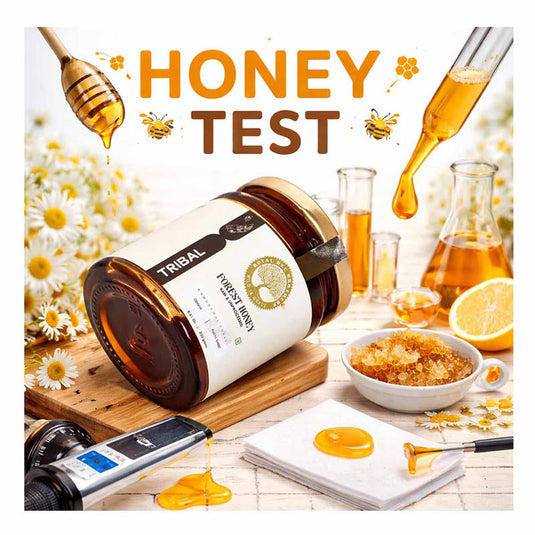
10 Popular Home Tests for Honey
1) The Water Test
- Add a spoon of honey into a glass of water
- Pure honey sinks; fake dissolves quickly (not always reliable)
- Verdict: Rough observation, not proof
2) The Paper Test
- Drop honey on paper
- May indicate moisture but unreliable
3) The Flame Test
- Depends on moisture, not authenticity
- Verdict: Myth
4) The Thumb Test
- Checks thickness only
- Verdict: Not scientific
5) The Vinegar Test
- Does not detect modern adulteration
- Verdict: Limited
6) Crystallization
- Natural process
- Does not confirm or deny purity
7) Heat Test
- Alters honey
- Verdict: Not recommended
8) Taste & Smell
- Can indicate quality but not proof
9) Bread Test
- Not reliable
10) Laboratory Testing — The Only Real Proof
This is where the conversation changes.
If you truly want to know whether honey is authentic, lab testing is the gold standard.
Advanced testing can evaluate:
- Sugar profile
- Moisture
- Acidity
- Enzyme activity
- Hydroxymethylfurfural (HMF)
- Pollen and source indicators
- Syrup adulteration markers
- Invert sugar signals
- Microbial load
- Mineral content
- Contamination risk
Advanced methods may include:
- NMR-based screening
- Sugar profile analysis
- Microscopy / pollen-related evaluation
- Physicochemical profiling
- Targeted adulteration detection
- Advanced pattern recognition / machine-learning assisted analysis
Verdict
- Home tests are clues. Lab tests are evidence.
The Big Truth Most Honey Blogs Don’t Tell You
Truth #1: Fake Honey Can Pass Home Tests
A sophisticated adulterated honey can be designed to imitate:
- Density
- Color
- Viscosity
- Flow behavior
- Surface texture
- Sweetness profile
That means a fake honey may:
- Sink in water
- Feel thick on the thumb
- Look rich and golden
- Smell sweet
- Even appear to crystallize in some cases
This is why viral shortcuts are dangerous.
Truth #2: Pure Honey Can Fail Home Tests
A genuine raw honey may behave differently because of:
- Higher natural moisture
- Seasonal variation
- Wild floral diversity
- Temperature
- Storage conditions
- Harvest timing
- Geographic origin
- Natural enzyme and sugar balance
That is especially important with forest honey and wild-harvested honey.
Truth #3: Honey Is One of the Most Faked Foods in the World
Globally, honey is one of the most vulnerable products for adulteration.
Why?
- High value
- Easy to dilute
- Hard for consumers to verify
- Often marketed with emotional claims like “natural” and “pure”
Truth #4: Even Taste Alone Is Not Enough
Modern adulterated honey can mimic:
- Sweetness
- Thickness
- Color
- Mouthfeel
Even experienced consumers can be misled.
What Beekeepers & Experienced Buyers Say
Home tests are not reliable enough to prove authenticity.
- Use home tests as signals
- Use common sense as protection
- Use lab reports as decision-making tools
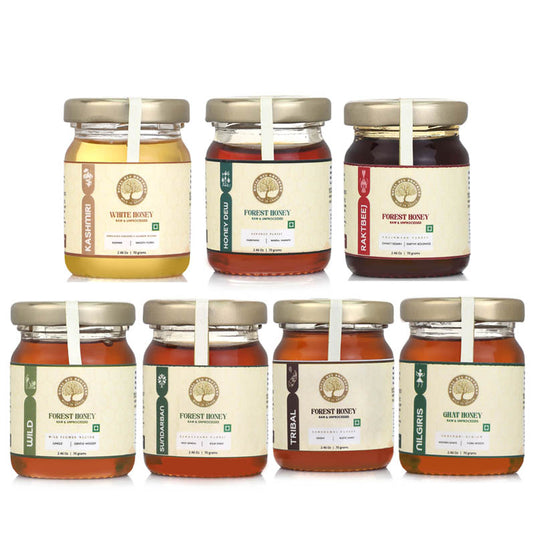
The Royal Bee Brothers Promise
What we stand for
- 100% Raw Honey
- No unnecessary overheating
- No aggressive processing
- No artificial standardization
- Unfiltered & Naturally Rich
- Retains natural character
Zero Adulteration Commitment
- No added sugar syrup
- No rice syrup
- No corn syrup
- No invert syrup blending
- No artificial sweeteners
Forest-Sourced Authenticity
- Harvested from natural ecosystems
- Rooted in real origin
- Reflects seasonal variation
Transparency Over Hype
- We do not ask customers to blindly believe
- We believe in showing proof
Lab Testing in NABL Certified Labs
Testing ensures quality through validated systems and standards.
Parameters Tested
- Fiehe’s Test
- Syrup Test
- Invert Sugar Test
- Added Sugar Check
- Sucrose
- Ash Content
- Acidity
- pH Value
- Diastase Activity
- HMF
- Phosphorous
- Sodium
- Bacterial Count
- Coliform
- E. coli
- Salmonella
Why These Tests Matter
- Identify adulteration
- Check enzyme health
- Ensure safety
- Validate authenticity
Transparency
- Reports available on website
- Latest report included with every bottle
Why Our Honey Tastes Different
It reflects real forests, real flowers, and real ecosystems.
It tastes like flowers you cannot name, trees you may never have seen, and landscapes that still remember how to be wild.
How to Choose Better Honey (Expert Buying Advice)
Instead of relying only on viral tests, use a smarter checklist.
1) Read the label carefully
Look for:
- No added sugar
- No glucose syrup
- No fructose syrup
- No corn syrup
- No rice syrup
- No artificial flavoring
2) Choose brands that show evidence
A trustworthy honey brand should be willing to share:
- Lab testing details
- Batch transparency
- Harvest origin
- Processing approach
- Real educational information, not vague claims
3) Understand crystallization properly
Crystallization is often normal. Do not assume:
- Crystallized = always pure
- Liquid = always fake
Context matters.
4) Pay attention to aroma and taste
Real honey usually has character:
- Floral, Herbal, or Woody
- Resinous or Earthy
- Sometimes slightly bitter or complex
If a honey tastes only like plain sweetness with no personality, ask questions.
5) Be cautious of ultra-cheap honey
If the price feels unrealistically low, there is often a reason. Authentic honey involves bee foraging, seasonal variability, and quality lab testing.
Can You Test Honey at Home?
Yes — but only to a point. Home tests can help you observe thickness and aroma, but they cannot reliably prove a lack of syrup adulteration or enzyme damage.
The final answer is simple: Home tests are helpful indicators. Lab testing is the only reliable proof.
Royal Bee Brothers Promise of Purity
Raw. Unfiltered. Tested. Transparent.
- 100% raw honey
- No added sugar or syrup
- NABL certified lab tested (Fiehe’s, HMF, Diastase, etc.)
- Test reports available on our website and included with every bottle
Scientific Reference Links
- Honey Adulteration Review: Read scientific review
- Honey Composition & Authenticity: Read composition & authenticity paper
- Advanced Honey Authentication Methods: Read advanced honey authenticity review
- HMF + Diastase Study: Read HMF and diastase study