The Heart of the Wild: The Eternal Majesty of the Saranda Forest
In the southern reaches of Jharkhand, bordering the state of Odisha, lies a realm where time seems to stand still—the Saranda Forest. Known intimately to the indigenous Ho tribe as the "Land of Seven Hundred Hills," Saranda is not merely a geographic location; it is an ecological cathedral. It stands as a sprawling, breathing testament to India's raw, unadulterated wilderness, harboring mysteries, ancient traditions, and a delicate ecological balance that has endured for millennia.
The Geographical Tapestry of the Seven Hundred Hills
Spanning an awe-inspiring expanse of over 820 square kilometers within the West Singhbhum district, Saranda is celebrated as the largest contiguous Sal (Shorea robusta) forest in all of Asia. Its topography is a dramatic, undulating canvas of rugged hills, deep gorges, and high plateaus. The elevation ranges wildly, creating a distinct micro-climate that nurturs flora and fauna unique to Central India.
Topography and Climate
The forest rests upon a bedrock of rich iron ore, which gives the soil its characteristic deep crimson hue. This iron-rich, lateritic soil, combined with heavy monsoonal rains, creates a fertile ground for dense vegetation. The climate within Saranda is distinct from the surrounding plains; even during the peak of Indian summers, the deep valleys remain shrouded in a cool, damp mist. In winter, the temperature plummets, wrapping the ancient trees in thick, ethereal fogs that linger until midday.
The Lifeline Rivers
The lifeblood of this vast ecosystem comes in the form of two majestic rivers: the Koel and the Karo. These perennial rivers, along with countless seasonal streams and rivulets, snake their way through the valleys. They do not just provide hydration to the dense foliage but act as vital watering holes for the diverse wildlife, carving out rich riparian zones that are hotbeds of biodiversity.
A Botanical Wonderland: The Flora of Saranda
To enter Saranda is to step beneath an ancient, living roof. The botanical diversity here is staggering, offering a pristine glimpse into the primordial forests that once covered much of the Indian subcontinent.
The Sacred Sal and the Forest Canopy
The dominant feature of Saranda is its dense, towering Sal cover. These magnificent trees reach skyward, their intertwining branches creating a nearly impenetrable canopy that filters the fierce tropical sunlight into soft, dappled shafts of emerald light. During the spring, the Sal trees shed their old leaves and burst into a spectacular display of pale yellowish-white flowers, filling the forest air with a heavy, sweet, and intoxicating fragrance.
But Saranda is not a monoculture. The Sal is interspersed with other native giants such as the Mahua (Madhuca longifolia), Kusum (Schleichera oleosa), Asan (Terminalia elliptica), and Palash (Butea monosperma)—the famed 'Flame of the Forest.' Each of these species plays a critical role in the ecosystem, providing sustenance to both wildlife and indigenous communities.
The Medicinal Wealth of the Forest Floor
Beneath the towering canopy lies a dense undergrowth teeming with medicinal herbs, rare ferns, and wild orchids. The indigenous tribes have cataloged hundreds of these species over centuries. Plants like Sarpagandha (used for blood pressure) and Kalmegh (a potent liver tonic) grow wild in the shadows. This rich, untainted floral diversity is exactly what makes the forest's natural produce, particularly its wild honey, so extraordinarily potent and complex.
A Sanctuary for the Wild: Fauna of the Singbhum Elephant Reserve
Saranda is a critical node in the Singbhum Elephant Reserve, a protected area designed to conserve the habitat of the Asian Elephant. The forest provides a safe corridor for these nomadic giants as they traverse the states of Jharkhand, Odisha, and Chhattisgarh.
The Gentle Giants and the Predators
The elephants of Saranda are the architects of the forest. By moving through the dense undergrowth and dispersing seeds over vast distances, they actively shape the ecology of the region. Alongside the elephants, the deep woods are home to leopards, sloth bears, wild boars, and the elusive Indian giant flying squirrel. While the tiger population has dwindled over the decades, the deep interiors still occasionally reveal pugmarks, whispering of the apex predator's enduring, albeit fragile, presence.
Avian and Micro Biodiversity
For ornithologists, Saranda is a paradise. The canopy echoes with the calls of the Indian Pitta, the Malabar Pied Hornbill, and various species of owls and woodpeckers. On a microscopic level, the forest is alive with countless species of insects, most notably the wild honeybees that thrive in the unpolluted, chemical-free environment, far removed from the monoculture of modern agriculture.
The Ho Tribe: Guardians of the Green Canopy
The story of Saranda cannot be told without revering its original inhabitants—the Ho tribe. For generations, the Ho people have lived in symbiotic harmony with the forest. To them, Saranda is not a resource to be exploited, but a living, breathing entity worthy of worship.
Animism and the Sarna Religion
The Ho tribe practices the Sarna religion, which is deeply rooted in animism and nature worship. Central to their faith is the Sarna Sthal or sacred grove—a patch of primeval forest left entirely undisturbed, where the village deities reside. Trees, rivers, and hills are considered sacred. The Sal tree, in particular, holds supreme religious significance, and its flowers are essential to their major festival, Sarhul, which celebrates the advent of spring and the blossoming of the forest.
Traditional Ecological Knowledge (TEK)
The traditional ecological knowledge of the Ho people is profound. They possess an intimate understanding of the forest's cycles, knowing exactly when to harvest wild tubers, when the Mahua flowers will fall, and when the wild bees have capped their honeycombs. Their harvesting methods are inherently sustainable; they take only what is needed, ensuring that the forest's ability to regenerate is never compromised.
Liquid Gold: The Wild Forest Honey of Saranda
Amidst the varied bounties of Saranda, none is perhaps as revered as its wild forest honey. Harvested from the treacherous cliffs and the highest branches of ancient Sal trees, this honey is a culinary and medicinal masterpiece crafted by the Apis dorsata—the Giant Rock Bee.
The Foraging Grounds
Because Saranda is completely isolated from industrial agriculture, the wild bees forage exclusively on native, medicinal flora. The resulting honey is a multifloral wonder. Depending on the season, the bees might collect nectar from the Sal, the sweet Mahua, or the medicinal Kusum tree. This diet imparts a deep amber hue and an incredibly complex, robust flavor profile to the honey, featuring deep woody notes, a hint of smokiness, and a delicate floral finish.
The Art of Ethical Honey Hunting
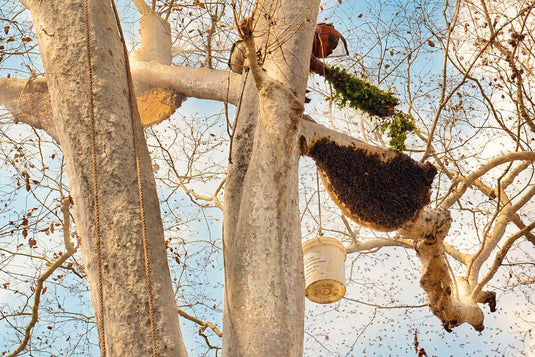
The honey harvesting in Saranda is an ancient art. Tribal honey hunters undertake perilous climbs using ropes crafted from forest vines. They employ traditional, non-destructive methods, using smoke derived from specific leaves that gently sedates the bees without harming them. Crucially, ethical harvesters cut only the honey-bearing portion of the comb, leaving the brood (the developing bees) and a portion of the honey intact. This ensures the survival of the colony and the continuous pollination of the forest.
Nutritional and Medicinal Profile
Due to its raw, unpasteurized nature, Saranda forest honey retains all its natural pollen, enzymes, and antioxidants. It is inherently rich in antibacterial properties and has been used in indigenous medicine to treat respiratory ailments, heal wounds, and boost immunity. It is not merely a sweetener; it is a concentrated dose of the forest's vitality.
Ecological Challenges and the Path Forward
Despite its remote majesty, the Saranda forest is currently standing at a fragile crossroads. The very earth that supports this magnificent ecosystem is rich in high-grade hematite iron ore, making it a focal point for intense mining activities.
The Impact of Mining
Decades of mining have inflicted deep scars on the landscape. Deforestation for mining leases, the runoff of red iron oxide into the pristine Koel and Karo rivers, and the heavy movement of machinery have fragmented wildlife corridors and disturbed the delicate hydrological balance. The dust from the mines settles on the foliage, impacting photosynthesis and threatening the botanical diversity that the wild bees rely upon.
Conservation and Sustainable Livelihoods
The preservation of Saranda requires a multifaceted approach. Strict regulation of mining activities, reforestation of degraded lands, and the protection of elephant corridors are vital. However, true conservation can only be achieved by empowering the local tribal communities. By creating sustainable livelihood models—such as the ethical harvesting and premium positioning of non-timber forest products (NTFPs) like wild honey, beeswax, and medicinal herbs—we can ensure that a living forest is economically more valuable than a felled one.
An Enduring Legacy
The Saranda Forest is a irreplaceable jewel in India's natural crown. It is a place of profound silence and vibrant life, of ancient traditions and timeless ecology. Choosing to appreciate, protect, and mindfully consume the natural gifts of such forests is not just a nod to premium quality—it is a conscious act of preservation. By valuing the untamed wilderness, we help ensure that the 'Land of Seven Hundred Hills' continues to thrive, sustaining both the wild creatures that roam its depths and the indigenous communities that call it home, for generations to come.
References & Further Reading
- 1. Forest Survey of India (FSI). "State of Forest Report: Jharkhand." Ministry of Environment, Forest and Climate Change, Government of India.
- 2. Wildlife Institute of India (WII). "Ecological Assessment of the Singbhum Elephant Reserve and Corridors." Dehradun.
- 3. Singh, S. & Prasad, R. "Ethnobotanical Studies of the Ho Tribe of Saranda Forest, Jharkhand." Journal of Economic and Taxonomic Botany.
- 4. Down To Earth Magazine. "The Rape of Saranda: The Impact of Iron Ore Mining on Asia's Largest Sal Forest."
- 5. Apimondia International Federation of Beekeepers' Associations. "Sustainable Honey Hunting Practices in Central Indian Forests."