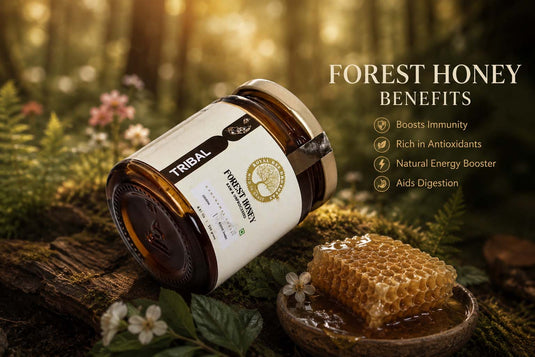
THE LIQUID GOLD OF JHARKHAND
A Comprehensive Exploration of the Rare, Medicinal, and Mystical Black Forest Honey of Saranda
Deep within the southwestern corner of Jharkhand’s West Singhbhum district lies an ancient, sprawling wilderness known as the Saranda Forest. Spanning over seven hundred hills, Saranda—whose name literally translates to "seven hundred hills"—is Asia's largest contiguous dense forest of Sal trees (Shorea robusta). This pristine, untamed canopy is home to unique indigenous tribes, vibrant wildlife, and an extraordinary ecological phenomenon: the production of a dark, rich, and highly therapeutic wildcraft honey known locally and globally as Saranda Black Forest Honey.
While the term "Black Forest Honey" traditionally conjures up images of the famous pine and fir honeydew produced in southwestern Germany, India boasts its own legendary equivalent. Jharkhand’s Saranda Forest honey is an exquisite mono-floral and multi-floral dark forest honey that shares the deep, enigmatic hues, complex flavor profile, and unparalleled medicinal strength of its European namesake, yet stands entirely distinct due to its tropical origin and unique floral composition.
Part I: The Voice of the Canopy (A Story of Saranda)
The sun had not yet cleared the canopy of the seven hundred hills, but the morning mist was already turning the color of crushed copper.
Deep within the heart of the Saranda Forest, in a small mud-and-thatch hut on the outskirts of a Ho tribal village, ten-year-old Shanti was awake. She sat on a woven mat, her eyes fixed on her father, Sukra, who was carefully checking his gear by the dim light of a kerosene lamp. Beside him lay a thick coil of wild sabaigrass rope, a hand-carved bamboo ladder, and several large, empty clay pots.
"Is it time, Baba?" Shanti whispered, pulling her hand-woven shawl tighter around her shoulders.
Sukra looked up, his weathered face breaking into a warm smile that crinkled the edges of his eyes. "Almost, little one. The wind from the south has stopped. The Apis dorsata—the great rock bees—will be calm this morning. The Sal trees have finished their spring bloom, and the combs are heavy with midnight gold."
In the tribal belt of West Singhbhum, Jharkhand, honey was not just something you bought in a jar; it was the sacred lifeblood of the forest. To Shanti’s people, the dense, untamed Saranda was a living deity. And today, Sukra was taking Shanti deep into the forest to witness the wild harvest for the very first time.

Into the Seven Hundred Hills
As the sky brightened into a pale yellow, father and daughter walked side-by-side along a narrow dirt trail. The air smelled of damp earth, wild orchids, and the sharp, clean scent of Shorea robusta—the giant Sal trees that soared a hundred feet into the air like columns of a green cathedral.
Shanti trotted to keep up with her father’s long, practiced strides. "Baba," she asked, pointing up at a massive, ancient Sal tree whose trunk was wider than three men interlocking arms. "Why is our honey so dark? The merchant at the town market last year had honey the color of clear sunlight."
Sukra stopped and knelt, picking up a handful of dark, rich forest soil. He let it sift through his fingers.
"Light honey comes from fields where humans plant a single flower, Shanti," he explained softly. "But our Saranda honey is born from the whole jungle. The wild bees fly deep where no human roads go. They drink from the golden blossoms of the Sal, the sweet nectar of the Mahua, and the healing bark of the Arjuna. When the summer comes, they gather the sticky honeydew wept by the trees themselves. It is dark because it holds the soul of the earth."
The Ascent of the Hive Collector
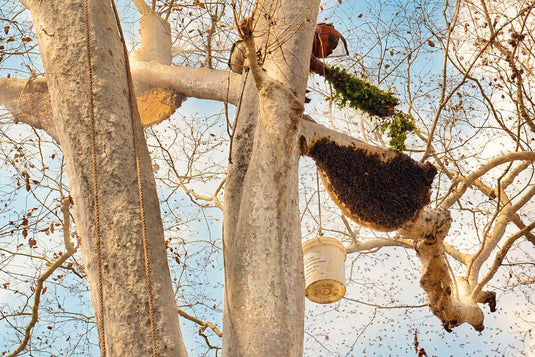
By midday, they reached a steep, rocky ravine. High above them, hanging from a massive, horizontal branch of a cliff-side Sal tree, was a magnificent, crescent-shaped honeycomb. It was easily four feet across, covered in a living, shimmering blanket of thousands of giant Asian rock bees. Shanti gasped, taking a step back. The collective hum of the hive vibrated right through the soles of her feet. "Are you not afraid, Baba?"
"We do not go as thieves, Shanti. We go as partners," Sukra said gently.
He unslung a bundle of dried forest grasses and green leaves he had gathered along the way. Striking a flint, he lit the bundle. It didn't burst into flames; instead, it produced a thick, sweet-smelling, white smoke. Leaving Shanti safely behind a thicket of ferns, Sukra tied the clay pot to his waist, slung the grass rope over his shoulder, and began to scale the massive tree. He climbed with the effortless grace of a man who had lived his whole life in the canopy.
Watching from below, Shanti held her breath. As Sukra neared the branch, he waved the smoking grass bundle beneath the hive. The giant bees didn't attack; calmed by the natural smoke, they slowly detached and moved upward into the higher branches, exposing the glistening, heavy comb.
Shanti watched as her father drew a sharp, curved bamboo knife. He didn't cut the whole hive down, as she had seen some desperate outsiders do in the lower valleys. Instead, he carefully sliced away only the outer, bulging dome of the comb—the honey storage cap. He left the inner part, where the baby bees slept, completely untouched. He lowered the heavy clay pot back down to the forest floor using the sabaigrass rope, then scrambled down after it.
Part II: The Foraging Chemistry – Honeydew vs. Floral Nectar
The plant diversity of Saranda is directly responsible for the dark pigmentation and intricate flavor of the honey. The primary canopy elements work harmoniously with unique geographical systems:
- Sal (Shorea robusta): Dominating over 70% of the forest canopy, the Sal tree produces delicate pale yellow flowers during early spring. Its resin and nectar impart a deep, grounding woodiness.
- Asan & Arjuna: Renowned for their profound cardiac and anti-inflammatory properties in traditional medicine, these trees provide nutrient-rich blooms that alter the chemical blueprint of the honey.
- Karanj & Mahua: The sweet blossoms of the Mahua tree add subtle fruity undertones and highly bioactive sugars, while Karanj offers exceptional antiseptic qualities.
A fascinating aspect of Black Forest Honey is how it transitions between floral nectar and honeydew honey depending on the seasonal cycles of the Saranda region.
| Attribute | Pure Floral Nectar Honey | Honeydew / Forest Honey |
|---|---|---|
| Primary Source | Flower blossoms (Sal, Mahua, Arjuna) | Plant sap & aphid secretions |
| Color Spectrum | Light amber to rich copper | Deep dark brown to obsidian black |
| Mineral Density | Moderate | High (Potassium, Iron, Magnesium) |
| Enzyme Diversity | Standard (Diastase, Invertase) | Enhanced (High Oligosaccharide content) |
During the peak spring bloom, the honey is highly floral, dominated by Sal and Mahua nectar. However, as the summer approaches, the trees secrete nutrient-rich phloem sap from their leaves and bark. The Apis dorsata bees eagerly collect this honeydew along with the late-season forest flower nectar, creating an incredibly low glycemic index food that resists rapid crystallization.
Part III: The Sensory and Flavor Profile
Connoisseurs of fine foods often compare Saranda Black Forest Honey to aged single-malt whiskies or single-origin dark chocolates. It is far from the one-dimensional sweetness found in commercial clover honeys.
The fire in the hearth crackled, throwing long shadows against the mud walls of the hut back at the village. Shanti sat cross-legged, watching her father pour the dark, slow-moving honey from the heavy clay pot into small glass jars. The air in the room became thick and intoxicating, smelling of damp leaves, toasted wood, and a deep, malty sweetness.
Upon the palate, Saranda honey delivers an evolutionary flavor experience. First comes an immediate, velvety wave of rich, dark caramel and molasses sweetness. On the mid-palate, the sweetness gives way to savory, earthy notes, with distinct hints of wood resin, leather, and dark chocolate. It concludes with a lingering, slightly bitter, and clean finish—a hallmark of high-antioxidant, low-sucrose forest honeys.

Part IV: Deep Dive into Therapeutic and Health Benefits
For centuries, the Ho, Munda, and Santhal tribes of the Saranda region have used this honey as a primary pillar of their traditional medicine.
"Baba," Shanti said, rubbing a small scrape on her knee she had gotten from a wild briar on the trail. "My leg stings a little."
Sukra looked down at her knee, dipped a clean wooden spoon into the jar, and brought out a dollop of the obsidian-amber liquid. Instead of offering it to her to eat, he gently smeared the cool, thick honey directly over her scraped skin.
"There," Sukra murmured. "The great rock bees infuse this nectar with the spirit of the Arjuna and Karanj trees. It acts like an invisible shield, Shanti. It draws out the bad fluids and keeps the wound clean so no fever can enter your body. By tomorrow, the skin will begin to knit back together."
Shanti watched the dark honey sit over her scratch. It didn't run down her leg; it stayed thick and protective. Intrigued, she licked a stray drop that had fallen onto her thumb. The initial burst of rich caramel and smoky molasses made her smile, but as she swallowed, a warm, slightly medicinal burn coated the back of her throat. "It feels warm when it goes down," she noted.
"That warm burn is the true medicine of the Black Forest," Sukra explained, adjusting the logs on the fire. "When the cold winds blow through the West Singhbhum hills in the winter, and the dry cough seizes the chests of the elders, a single springboard of this dark honey calms the throat. It coats the breathing pipes like oil on a squeaky hinge, soothing the rawness and killing the invisible bugs."
Key Scientifically Proven Benefits:
- Superior Antioxidant Capacity: High concentrations of polyphenols and flavonoids block cell damage from free radicals.
- Natural Anti-Inflammatory Effects: Contains specific phytochemicals that inhibit pro-inflammatory pathways (IL-6 and TNF-alpha).
- Enzymatic Antibacterial Action: The enzyme Glucose Oxidase continuously generates therapeutic micro-doses of hydrogen peroxide ($H_2O_2$) when applied to skin moisture.
Part V: Tribal Customary Laws vs. Modern Exploitation
The preservation of the Saranda Forest by the Ho and Munda tribal communities is rooted in an ancient legal framework known as the Munda-Manki system (for the Ho) and Parha Raja system (for the Munda). Under these customary rules, resource extraction is strictly managed:
Through mechanisms like the Khuntkatti System (collective community ownership) and the absolute protection of the Sarna Sthal (sacred groves where it is forbidden to pluck even a single leaf), indigenous laws prevent the commercial decimation of the jungle. The "Half-Cut Rule" in honey harvesting ensures that the brood nests of the bees are preserved intact, safeguarding biodiversity for generations to come.
Part VI: Authenticity Testing and Preservation
Because of its high market value and scarcity, dark forest honeys are vulnerable to adulteration. Genuine purity can be evaluated through basic physics and chemistry indicators.
To preserve your raw honey's active organic components, make sure it is stored in an inert glass container away from direct sunlight, and never heat it above 40°C (104°F), which permanently denatures its structural enzymes.
Conclusion: A Jar of Untamed Wilderness
As they walked back to their village, the heavy clay pots balanced safely on Sukra’s shoulders, the sunset turned the Saranda hills into waves of purple and gold.
"Baba," Shanti said, holding her father's calloused hand. "If we leave the rest of the hive on the branch, will the bees come back?"
"They will rebuild it within a few weeks," Sukra replied proudly. "If we take everything, the bees die, and the forest stops fruiting. But because we take only what we need, the bees will stay, the trees will grow, and when you are a mother, you will bring your own children to this very same ravine."
Shanti looked back at the vast, whispering canopy of the Saranda Forest. She understood now. The midnight honey in their pots wasn't just a treat to be sold at the market; it was a promise kept between her people and the ancient forest they called home.

Explore Our Other Stories
From wild forests to ancient traditions, discover more untold journeys of nature, honey, and heritage.
Exploring India’s Wild Bounty
Stories of ancient wisdom, wild honey traditions, sacred forests, and nature’s timeless connection with humanity.
Mahwa: The Sacred Flower of Bastar
Mahwa symbolizes tribal culture, forest traditions, natural abundance, spirituality, and sustainable indigenous living.
Bastar’s Chapda Chutney
Bastar’s Chapda Chutney is a mysterious tribal delicacy, blending forest traditions, red ants, bold flavors, and ancient indigenous heritage.
The Honey Hunter of Katarniyaghat
Discover wild forest honey traditions, tribal honey hunters, jungle survival, natural heritage, and untamed wilderness stories.
Tales from Sundarban ! Part-1
Explore how mangroves protect coastlines and sustain rare biodiversity in tidal forests.
Tales from Sundarban ! Part-2
In Sundarbans folklore, Bengal tigers guard wild honey forests, where fearless honey hunters journey through dangerous mangroves for survival.
The Lush Forests of Kandhamal & Honeyguide
Mythical stories that define the spiritual balance between humans, birds, and forest.